Chronic Back Pain and Sciatica for 3 Years With No Answers: A Case Study in Neurologic Sensitivity
Years of back pain and sciatica. Chiropractic, pelvic floor therapy, physical therapy, dry needling, yoga. Explanations that never quite fit. If that sequence sounds familiar, this case study is for you. It's a composite drawn from a client I worked with, with details changed to protect her privacy, and it illustrates what happens when the neurologic piece of persistent back pain gets missed, and what changes when it finally gets addressed.
"Why Are You Walking Like That?"
When her husband asked, "Why are you walking like that?" she wasn't angry. She wasn't embarrassed.
She was relieved.
To understand why a question like that could feel like relief, you need to know what the three years before it had been like.
Three Years of Shrinking
She was in her mid-thirties with two kids, and she had always been the active one. Sports, her kids' activities, lifting, running. Movement was part of who she was.
Then her back pain and sciatica started, and for three years they progressively got worse. Little by little, her life got smaller. First she stopped running. Then lunges. Then deadlifts. Each one felt like a reasonable concession at the time. Together, they added up to a person who no longer recognized her own body.
She did what a motivated person does. She tried chiropractic care. Pelvic floor therapy. Physical therapy. Dry needling. Yoga. Instead of answers, she kept getting explanations that didn't quite fit what she was experiencing.
"Back pain is just a normal part of being a mother."
"This is just part of your journey now."
Neither statement is a diagnosis. Both are ways of saying "I don't know what's driving this" without saying it.
When the Symptoms Got Worse, the Explanation Got Worse
Eight weeks into physical therapy, things got significantly worse. Her foot would go numb after walking for only a few minutes. She was waking at night with nerve pain down her leg.
She went into her next PT appointment in tears, because she knew something wasn't right. New symptoms, a new pattern, a clear change from where she'd started. That is exactly the moment a clinician should get curious.
Instead of investigating, she was asked: "Are you sure you're really in pain? Maybe you're just upset. I think that's what this is."
She left that appointment with a recommendation to see a trauma therapist.
She Had Already Done That Work
Here is the part that made it land so hard. She had already done that work. Years of it. She had lost someone unexpectedly and had walked through that grief deliberately, with support, over a long time.
So the message she heard wasn't "let's address an overlooked factor." The message she heard was: "You can't overcome your experiences. You're a hostage to things in your life you had no control over."
Every one of those appointments, she told me, chipped away at her confidence in what she was feeling. When enough professionals tell you that your body isn't doing what you can feel it doing, you start to doubt the one source of information you have.
This is the pattern I've written about in When Neuroplastic Pain Becomes Medical Gaslighting. A psychological explanation offered in place of an investigation isn't compassion. It's a shrug with better vocabulary.
Why Being Seen Mattered
That's why her husband's question was a relief. He wasn't a clinician. He had no lens to look through. He simply looked at his wife and saw that she was walking differently. Someone else could see it.
She eventually reached the conclusion herself, before she ever found me: something really was off. Unresolved grief, hormones, and "just being upset" weren't adequate explanations for progressive numbness, night pain, and a changed gait.
There was a neurologic piece nobody had addressed.
Where We Started: The Neurologic Sensitivity Itself
That's where we started. Not with the things she'd already been offered.
We did not start by asking her to process her grief again. We did not start by telling her to accept this as her new normal. We did not start by shrinking her life around the activities that felt "safe," by trying to calm her system as the main solution, or by bulldozing through the pain the way she'd been doing for years.
We started by directly working on the neurologic sensitivity.
Changing How the System Responds to Input
Her signaling system had become more responsive over three years of pain, guarding, and fear. Inputs that shouldn't have been threatening, like walking for a few minutes, were producing large responses: numbness, nerve pain, a protective gait. The tissue explanation couldn't account for that. The neurologic one could.
So the first phase of work was specific training to change how her system responded to sensory and movement input. Graded motor imagery to address how her brain was mapping and representing her back and leg. Sensory discrimination to sharpen the information coming in. Modified neurodynamic techniques to address the nerve sensitivity directly, at a dose her system could tolerate.
Push to It, Not Through It
At the same time, I taught her how to keep moving and strengthening without repeatedly overwhelming the system. This is the principle I call "push to it, not through it." You find the edge of what your system tolerates today, you work to that edge, and you stop before you provoke the protective response that costs you the next three days. Then you move the edge.
For someone who'd lived by "no pain, no gain" for decades, this was the hardest skill to learn. It also turned out to be the one that made everything else possible. Pushing through had been keeping her sensitivity high. Pushing to it let it settle.
What Changed
There were multiple pieces we worked through over the course of the program, and progress wasn't a straight line. But once the overlooked neurologic factor was being addressed, things started changing in a way that three years of other approaches hadn't produced.
- The sciatica running down her leg into her calf faded, and then one day she noticed it simply wasn't there. It didn't return.
- Items on her "no" list came back, one at a time. Lunges. Deadlifts. Lifting heavy again, with no hesitation.
- Running returned. She described a run where, for the first time in longer than she could remember, her stride felt normal.
Her words for it: "You can't even put it into words when you're able to do the thing that you love again."
What This Case Shows About Persistent Back Pain
I don't share this because every case resolves like hers. I share it because of what it took to get there, and what it had been missing.
Her back pain wasn't a motherhood tax. It wasn't unprocessed grief. It wasn't a personality problem. It was a real physical problem that had developed a real neurologic component, and that component had been invisible to every clinician who was only looking at tissue or only looking at psychology. I wrote about why neither of those lenses is sufficient in Why Exercise Makes Chronic Pain Worse.
The goal all along was simple. Take what she was describing seriously. Figure out what had been overlooked. Give her something she could actually do about it. So she could get back to being herself again.
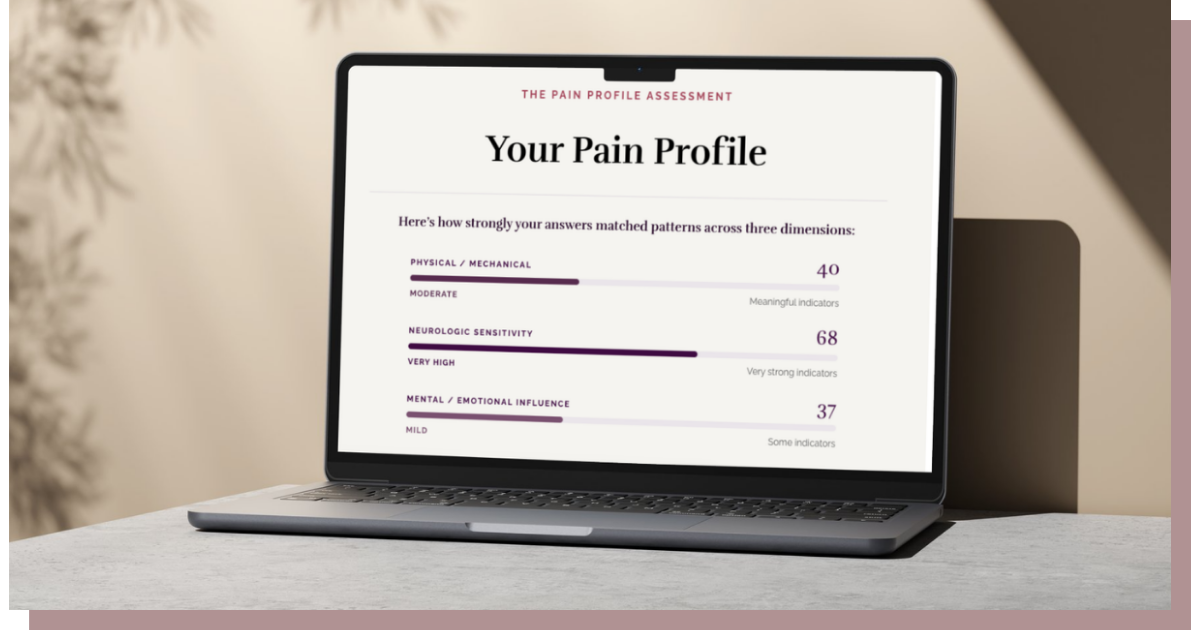
Not sure which dimension is driving your pain? Take the free Pain Profile quiz and get three separate scores: physical, neurologic sensitivity, and mental/emotional.
If neurologic sensitivity turns out to be the driver, that's exactly what The Uprising: Complex Pain Academy is built to address. It gives you a structured, five-phase process for directly targeting neurologic sensitivity while rebuilding movement and activity, without the push-and-crash cycle and without relying on cognitive, emotional, or stress-reduction techniques as the main solution.