Fear of Movement and Chronic Pain: How to Stop Fear From Driving Your Recovery
Pain can feel like it has a mind of its own. It shows up when it wants. It spikes for no reason you can identify. It changes from one day to the next, sometimes from one hour to the next. When something in your body is that unpredictable, it starts to feel like it's the one making the decisions: where you go, how long you stay, what you do and don't do. If that's where you are, this post is about who's actually driving, and how fear and pain get tangled together without one being the cause of the other.
Pain Is Driving, Anxiety Is Riding Shotgun
Here's the picture most people describe to me, once they have words for it. Pain is behind the wheel. Anxiety is in the passenger seat, telling the driver what to do and escalating everything. And you're in the back, just trying to hang on.
Every plan gets filtered through "what if it flares?" Every invitation gets measured against how you felt the last time. Every movement gets a risk assessment before it happens. That's exhausting, and it's also very normal, because pain and anxiety tend to travel together.
Fear and Pain Are Neurologically Linked
This is not a character flaw and it is not a coincidence. Fear and pain are tied together in the biology. Fear is a normal output of the protective response, the same system that produces pain in the first place. When your body decides something needs protecting, it recruits more than one tool to do it. Pain is one. Fear and heightened vigilance are others. They come as a package.
That does not mean fear or stress caused your pain. I want to be precise here, because a lot of people with persistent pain have been handed a version of "you're just anxious" and it did real damage. Fear is not the origin of your pain. It is one of the inputs that can change how much pain you experience. In my framework, that makes it an amplifier: something that doesn't start the fire but absolutely affects how big the fire gets.
Amplifiers are worth caring about precisely because they're modifiable. You can't go back and un-have the injury or the surgery. You can change what's feeding the signal today.
Why "Eliminate the Fear" Is a Losing Game
Once people learn that fear amplifies pain, the obvious conclusion is: get rid of the fear. Eliminate stress. Control every anxious thought. Keep your nervous system perfectly "regulated" at all times.
That is a losing game, and I don't set it as a goal.
You cannot stop every thought. You cannot prevent fear from showing up when your body has spent months or years learning that movement leads to consequences. Trying to achieve a fear-free state leaves most people beating themselves up over why they can't just think differently, and now there's a new amplifier in the car: shame about the fear. I've written about why the regulation-first approach stalls in Why Calming Your Nervous System Isn't Enough for Chronic Pain.
So let's change the goal.
Fear Can Be in the Car. It Doesn't Get to Drive.
We are not pretending fear isn't there. We are not kicking it out of the car, because that isn't an option anyone actually has. We're changing who's steering.
Fear can ride shotgun. It can offer commentary. It can point out every pothole. It just doesn't get the wheel. You do.
That reframe matters because it stops the fight. When the goal is "no fear," every anxious thought is a failure. When the goal is "fear doesn't decide," an anxious thought is just a passenger talking, and you can keep driving.
What Actually Shifts Fear: Evidence, Not Effort
Here's where it gets practical. What loosens fear's grip isn't thinking harder. Reasoning with fear rarely works, because fear isn't built on reasoning. It's built on experience.
So you change the experience. Fear shifts in response to evidence:
- Every movement that didn't produce the reaction you braced for.
- Every tool that helped more than you expected it to.
- Every small win that your body registers before your mind catches up.
Each of those is proof. And proof is the only thing that breaks fear down instead of reinforcing it.
Avoidance reinforces fear, because the body never gets the chance to learn the movement was safe. The push-and-crash cycle reinforces fear too, because the body learns that movement really does lead to consequences. Both patterns feed the passenger. Neither one hands you the keys.
This Is Why I Say "Push to It, Not Through It"
Pushing through pain gives fear more evidence that movement is dangerous. Avoiding pain gives fear no evidence at all. Pushing to it, finding the edge of what your system tolerates today and working right there, is what generates the kind of proof that changes the relationship. Enough challenge to show the body something new. Not so much that the lesson becomes "see, I told you."
Over time, the proof accumulates. The passenger gets quieter, not because you argued it into silence, but because it ran out of material. I go deeper on how this loop forms and how to interrupt it in How to Break the Fear and Pain Cycle.
Where Fear Fits in a Complete Plan
Addressing fear is necessary. It is not sufficient. If neurologic sensitivity is driving your pain, overactive pathways that have become easier to activate and slower to settle, then reducing amplifiers helps, but the signaling system itself still needs to be trained. That's a different kind of work: graded motor imagery, sensory discrimination, neurodynamic techniques, and pacing built for a system that overreacts. The fear work and the signaling work belong in the same plan, in the right order.
Fear can ride shotgun. It just doesn't get the keys.
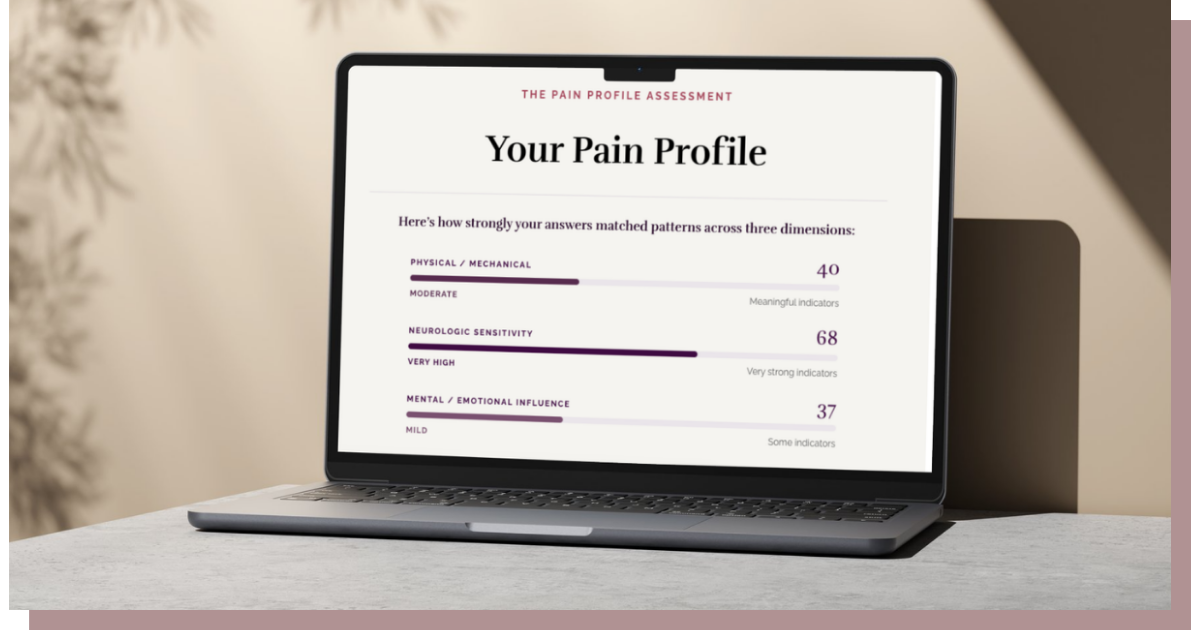
Not sure which dimension is driving your pain? Take the free Pain Profile quiz and get three separate scores: physical, neurologic sensitivity, and mental/emotional.
If neurologic sensitivity turns out to be the driver, that's exactly what The Uprising: Complex Pain Academy is built to address.