Should You Ignore Chronic Pain or Pay Attention to It? Why Both Extremes Backfire
"Am I supposed to think about my pain, or not think about it?" Someone asked me that on a coaching call recently, and I've heard the same question in a dozen different forms over the years. It's a fair question, because the pain world has made the answer far more complicated than it needs to be. One camp says ignore it completely. The other camp hands you a symptom-tracking app. Both are wrong in the same way, and the skill that actually helps sits in between them.
The "Never Think About It" Camp
There's a popular school of thought that says: never think about your pain. Stop checking your symptoms. Distract yourself. Don't even use the word "pain." The logic is that attention feeds the pain, so starving it of attention will shrink it.
I don't love this. There's a kernel of truth in it, attention does matter, but the conclusion overshoots badly. Pretending pain isn't there is not a strategy. It's a dare.
Symptoms give you useful information. They tell you where your limits are today, which activities your system is tolerating, and when something is changing. If you completely ignore that information, you blow right past your limits and pay for it later. That's the engine of the push-and-crash cycle: ignore, overdo, collapse, recover, repeat. Nobody who lives in that cycle makes consistent progress, because the body never gets a stable enough stretch to adapt.
The "Track Everything" Camp
The opposite extreme is just as common and just as unhelpful. Constant checking all day long. Rating every sensation. Logging every twinge in an app. Scanning the body for anything that might be starting.
When every sensation gets analyzed under a microscope, pain starts taking up more space than it needs to. Hypervigilance is itself an amplifier. It doesn't cause the pain, but it changes how much of your day the pain occupies and how strongly your system responds to ordinary input. A body that's being monitored for threat tends to find some.
So both extremes create a problem. One ignores the information. The other drowns in it.
The Healthy Middle: Noticing Just Enough
Every person has a middle ground where they pay enough attention to get useful information, but not so much that every symptom gets to run the day. That middle ground is where the actual skill lives.
The skill is noticing just enough.
Enough to know your pattern. Enough to recognize the difference between a sensation that means "adjust" and one that means nothing at all. Enough to catch an early flare before it becomes a big one. Not so much that you're interviewing your knee every fifteen minutes.
The Line Moves, and That's Normal
Where that line sits is different for every person, and it moves over time. Sometimes you need to pay more attention for a while, so you can actually learn your patterns. If you've never figured out what your body does after a long walk versus a long drive, you can't pace either one. A short period of deliberate attention is how you build that map.
Other times you need to pay less attention, and stop checking every sensation quite so closely, because you already know the pattern and the checking has become its own habit. Neither direction is the permanent answer. The adjustment is the skill.
Why This Matters for "Push to It, Not Through It"
I talk constantly about pushing to it, not through it: finding the edge of what your system tolerates and working right there, instead of charging past it or avoiding it altogether. That principle only works if you can notice your symptoms without letting them run the show.
You can't find the edge if you refuse to look at the map. You also can't move toward anything if you're staring at the map the whole time. The middle ground is what makes pacing possible, and pacing is what makes consistent progress possible for a system that overreacts.
This is also why I approach flare-ups the way I do. A flare is information, not a verdict. You notice it, you adjust, and you keep going. I've laid out the specifics in How to Handle a Flare-Up.
Attention Is an Input, Not the Diagnosis
One more thing, because this is where people get hurt. Nothing in this post means your pain is caused by paying attention to it. Attention is one modifiable input among many. It can change how much pain you experience without being the reason the pain exists. If your pain is being driven by neurologic sensitivity, overactive pathways that have become easier to activate and slower to settle, then adjusting your attention helps, and it is nowhere near enough on its own. The signaling system itself still needs to be trained, through graded motor imagery, sensory discrimination, neurodynamic techniques, and pacing built for a sensitive system. Getting your attention right is what lets you do that work well. It isn't a substitute for it.
If you've been told to simply stop thinking about your pain and it hasn't worked, that's not a failure of discipline. It's a plan that was never complete. I've written about what the complete version looks like in Why Calming Your Nervous System Isn't Enough for Chronic Pain.
Check the Rearview Mirror
Think of it like driving. You check your rearview mirror. You look, you register what's there, and your eyes go back to the road.
Never looking is dangerous. You'll get hit by something you could have seen coming. Never looking away is dangerous too. You'll drive straight into whatever's in front of you while watching what's behind.
Glance. Register. Eyes back on the road.
That's the whole answer to "should I think about my pain or not." Not never. Not always. Just enough.
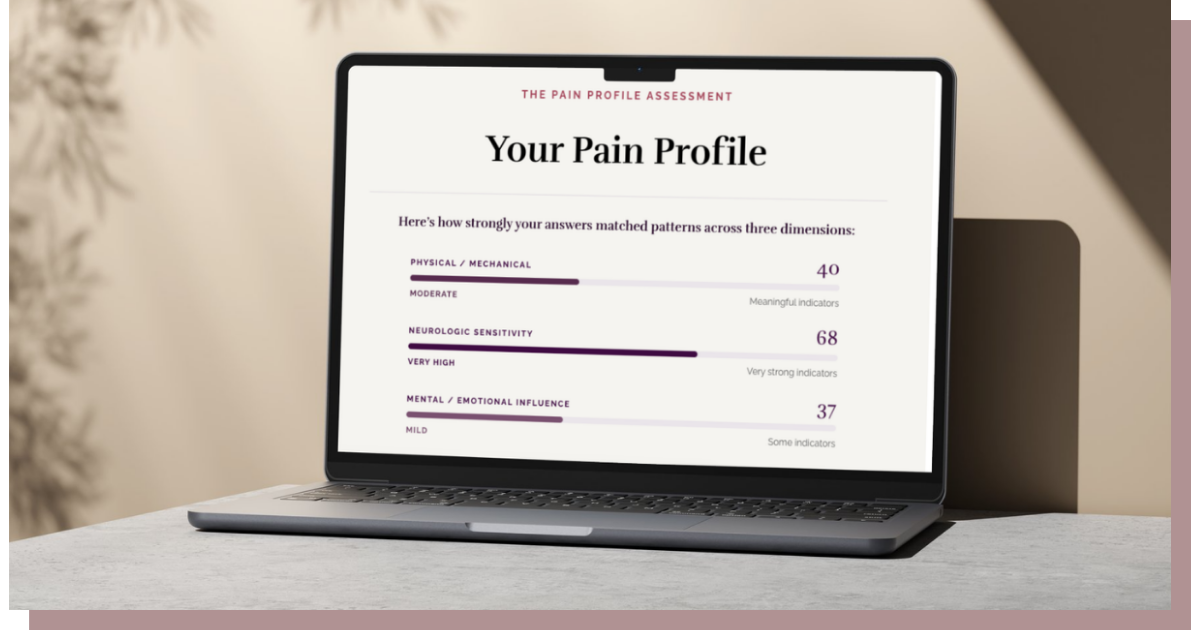
Not sure which dimension is driving your pain? Take the free Pain Profile quiz and get three separate scores: physical, neurologic sensitivity, and mental/emotional.
If neurologic sensitivity turns out to be the driver, that's exactly what The Uprising: Complex Pain Academy is built to address.