Newly Diagnosed With CRPS? Why Early Treatment Means Acting Fast, Not Pushing Hard
If you've recently been diagnosed with Complex Regional Pain Syndrome, you've almost certainly heard that early intervention matters. It does. But somewhere between the diagnosis and the treatment plan, "act early" tends to get translated into "do everything, as hard as you can, right now." That translation is wrong, and with CRPS it's costly. Here is why acting fast and pushing hard are not the same thing, illustrated by a client whose story I've anonymized.
"Pain Is Weakness Leaving the Body"
Someone gave her that quote before an endurance race years ago, and she loved it. It summed up how she'd approached pain for decades.
She was the definition of an active person. Distance running, long bike rides, multi-sport endurance events, cross-country skiing. She was not a stranger to pain or physical discomfort. Pushing through it was a skill she'd spent a lifetime sharpening.
Then, two days after foot surgery, she was in the emergency room, certain something was wrong. It took time to get the answer, but eventually she learned it was CRPS.
And she approached it exactly the way she'd approached every other pain and injury in her life. She pushed herself.
The Six-Month Clock
Within the first few months she was doing physical therapy, desensitization, mirror therapy, massage, lymphatic drainage, and pool exercise. She was researching nerve blocks, ketamine, medications, and hydrodissection. If a treatment existed, she was either doing it or reading about it.
Because somewhere along the way, she had read that after six months, CRPS recovery becomes harder. In her mind, the clock was ticking.
To her, that meant one thing: do as much as possible, all at once, and push through whatever happened. She was terrified of wasting the window.
How "Early Intervention" Gets Mistranslated
I see this constantly with people newly diagnosed with CRPS. You're told early intervention matters, which is true. And somehow that becomes: "Do more. Push harder. Do it all now. You're running out of time."
Yes, early intervention matters. But early does not mean "do more," and it does not mean "push yourself harder."
In fact, with CRPS, pushing harder usually costs you more than it gains you.
Why Pushing Hard Backfires With CRPS
CRPS is, at its core, a disorder of the sensory signaling system. The nerves and pathways responsible for detecting, transmitting, processing, and responding to information have become unusually sensitive and reactive. That is why a light touch burns, why the limb swells and changes color, and why the pain is out of proportion to the original injury.
When the signaling system is this reactive, small inputs produce large responses. That is the defining feature of the condition.
So consider what happens when you stimulate that system by doing too much, all at once. You don't make faster progress. You provoke a protective response that is already primed to fire, and you spend the next several days recovering from a flare-up instead of building on yesterday. Do that repeatedly and the system learns that movement is a threat, which is the opposite of what you're trying to teach it.
The "no pain, no gain" mentality works on healthy tissue with a normal signaling system. CRPS plays by a different set of rules. A system that is already overreacting does not need to be overwhelmed into submission. It needs to be trained, in the right dose and the right order.
Push to It, Not Through It
As a specialist in complex pain, I encourage you to replace "no pain, no gain" with something far more useful: push to it, not through it.
Find the edge of what your system tolerates today. Work right up to that edge. Stop before you provoke the response that costs you days. Then, over time, move the edge.
She will tell you that was one of the hardest parts of this process for her. Backing off felt like quitting. Slowing down felt like weakness. Every instinct she'd built over decades of endurance sport told her the answer was more.
But learning how to normalize neurologic signaling and challenge her body without constantly bulldozing through its response became the most important part of moving forward.
What We Did Instead
We started by giving her structure. Strategies. A plan.
Not a bigger pile of treatments. A way to decide what to do, how much to do, and in what order, instead of trying to piece together random advice from medical appointments, an athletic trainer, and YouTube videos. If you want to understand why order matters so much with CRPS, including why I don't teach desensitization and why mirror therapy comes last rather than first, the CRPS series walks through it.
The work centered on addressing neurologic sensitivity directly: graded motor imagery to address how her brain was representing the affected foot, sensory discrimination to sharpen the information coming in, and movement reintroduced at a dose the system could tolerate and then progressed deliberately. Strengthening and weight-bearing came in on top of that foundation, not instead of it.
And as she implemented that approach, little by little, she started doing more.
The Cul-de-Sac
The first time she made it across her cul-de-sac on her bike, after months of not knowing whether she'd ever walk normally again, her husband caught up to her and found her giggling.
That is what progress looks like early on with CRPS. Not a marathon. A cul-de-sac. And it is a bigger deal than it sounds, because it was the first evidence her system could be trained rather than fought.
Where She Is Now
Today, she hikes and bikes distances measured in double-digit miles. She sleeps better. The swelling is down. She has gotten back to things that, in those first terrifying months, she wasn't sure she'd ever do again.
She has also come off the nerve medication she was started on early in the process. I want to be careful here, because medication decisions belong between you and your prescriber, and I'm not telling anyone to stop anything. But many people with CRPS are told to expect to stay on nerve medication indefinitely, as though the sensitivity is permanent and the only option is to dampen it. A sensitized signaling system is a trainable one. When the sensitivity settles, the conversation about what medication is still needed can change, too.
Urgency Is Not Intensity
Yes, early intervention matters. But more aggressive intervention is not automatically better intervention. With CRPS, sometimes doing less, more strategically, is what allows you to do more.
And if you're past the six-month mark, or well past it, the window did not slam shut. The six-month rule is a myth I address directly in the CRPS series. A signaling system that adapted in one direction can adapt again. Time doesn't take that away.
So if you're newly diagnosed and feeling like the clock is ticking, absolutely start moving, rebuilding, and addressing neurologic sensitivity. Start now. Start strategically and intentionally. But don't mistake urgency for intensity.
Push to it, not through it.
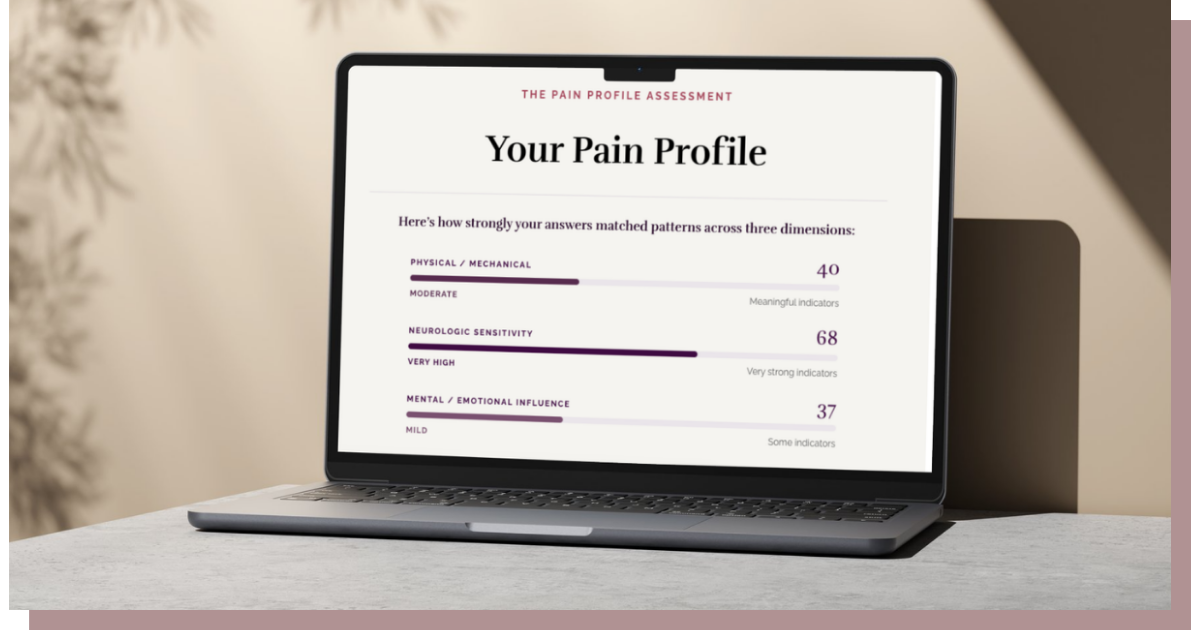
Not sure which dimension is driving your pain? Take the free Pain Profile quiz and get three separate scores: physical, neurologic sensitivity, and mental/emotional.
If neurologic sensitivity turns out to be the driver, that's exactly what The Uprising: Complex Pain Academy is built to address. Knowing what to do is only part of it. The program teaches how much, when, and what comes next, so you aren't piecing it together yourself while the clock feels like it's ticking.