Is There a Quick Fix for Chronic Pain? What to Ask Before Starting Another Treatment
If you've been living with complex or persistent pain for years, you've probably noticed that the question you want to ask every new clinician isn't really "what's wrong with me." It's "will this one finally work." I want to tell you about a conversation I had with a prospective client, because what she asked me for is what almost everyone asks me for, and I couldn't give it to her. What I could give her turned out to matter more.
"I'm Sorry, I Don't Want to Waste Your Time"
Within the first minute of our call, she was apologizing. Her case was "probably too complicated." She wasn't sure I could help her. She didn't want to take up my time.
I had some background on her situation before we talked. Years of symptoms. Some ongoing physical issues in the picture, though they didn't seem to explain everything she was experiencing. Very little on paper that accounted for the whole pattern.
And she had tried. Several rounds of injections. Nerve blocks. Medications. Physical therapy. Then a long stretch of the other side of the industry: mindfully tracking sensations, meditation, journaling, telling her brain she was safe. After all of that, plus hours of her own research, she admitted the overload of information had produced what she called "analysis paralysis."
She still had questions, and they came in a familiar order:
- "But my case is really complicated."
- "I've already tried so many things."
- "How do I know this will work for me?"
If you've asked some version of those questions, you're in good company. Nearly every person I talk to asks them. They're reasonable questions. But as the conversation went on, I realized they weren't really about my program.
The Question Underneath the Questions
Behind each concern was the same thing: the fear of disappointment.
She had gone all in before. More than once. She had paid for things, believed in things, done the homework, and watched them not work. Each time, something got taken out of her, and each time, the next thing got harder to try. That isn't a character flaw. That is exactly what the hope-cost-letdown cycle does to a person.
So what she wanted from me wasn't information about modules or methods. She wanted certainty. She wanted me to tell her she wasn't going to be disappointed again.
And I couldn't.
What I Can't Promise Anyone With Complex Pain
I couldn't promise she'd be pain-free forever. I couldn't promise exactly how her body would respond, how much progress she'd make, or how long it would take.
Nobody honestly could.
I can't give you 110% certainty that you'll be "cured," pain-free for the rest of your life, and running marathons or hiking Mount Everest four months from now. Any clinician or program that offers you that certainty is telling you something about their marketing, not about your prognosis. Complex pain involves a neurologic system that adapted over time, and a system that adapts doesn't come with a guaranteed schedule for adapting back.
Here is the part I didn't expect. Acknowledging that took some of the pressure off her.
When Certainty Isn't Available, Decide the Next Step
She realized the certainty she wanted was never going to be available. Not from me, not from the next specialist, not from the next program. Once that was on the table, the decision in front of her got much smaller.
She didn't need to know how the whole story would end. She only needed to decide on the very next step.
In her case, that next step was giving me enough information to answer a much smaller and more honest question: "Alissa, based on everything I've told you, do you actually think I'm a fit for this?"
That is a question I can answer. And it's the reason I use an application instead of a checkout button.
Why I Read Every Application Myself
I personally read every application before I invite someone to enroll in The Uprising: Complex Pain Academy. Not an assistant. Not an automated scoring system. Me.
Here is what that process is for.
If It Isn't a Fit, I'll Say So
If I don't believe my program is an appropriate fit for someone, it doesn't serve either of us to pretend otherwise. Those aren't fun emails to send. But sending someone into a program that isn't built for their situation is how the hope-cost-letdown cycle gets one more turn, and I refuse to be another turn of it. When the program isn't the right fit, I always try to point the person toward something that might actually be helpful.
The program is designed for people whose pain has a significant neurologic sensitivity component. That includes CRPS, persistent pain after a structural problem has been treated, pain that spreads or behaves unpredictably, and symptoms that nobody's imaging can account for. It is not built for every pain presentation, and I'm not going to pretend it is.
If It Is a Fit, You Still Decide
If I do think you're a fit, I'll send you information about your options: the Inner Circle, which is a sixteen-week, women-only cohort with weekly live coaching and direct messaging access to me, or Independent Study, which is the self-paced path through the same five-phase protocol. You'll have the opportunity to ask questions. You can schedule a time to talk with me if you'd rather discuss things in person.
And then you get to decide.
The application is free. It is not a commitment to join. It is the smaller, answerable question that replaces the enormous, unanswerable one.
Why the "Quick Fix" Question Is the Wrong Question
I want to name something about that conversation that applies far beyond my program.
When you've had complex pain for years, the question "will this fix me" quietly becomes the filter for every decision. It's understandable. It's also the question least likely to lead you anywhere useful, for two reasons.
First, nothing legitimate can answer it. The treatments that promise to are the ones to be most skeptical of.
Second, it pushes you toward the next singular fix instead of toward understanding what's actually driving your pain. Injections, nerve blocks, and medications address one dimension. Mindset and calming approaches address another. If the neurologic signaling system itself is sensitized, neither category was designed to change that, and no amount of cycling between them will. I go deeper on why in Why Calming Your Nervous System Isn't Enough for Chronic Pain.
The better question is: "Based on everything I know about my situation, what is the right next step?" That question has an answer. It can be acted on this week. And it doesn't require you to bet your whole hope on one outcome.
You Don't Have to Know How the Story Ends
If you're wrestling with that fear of disappointment, I'm not going to talk you out of it. You earned it honestly.
But you don't have to know how the story ends to take the next step. You only have to take one step at a time, with as much good information as you can get before you take it.
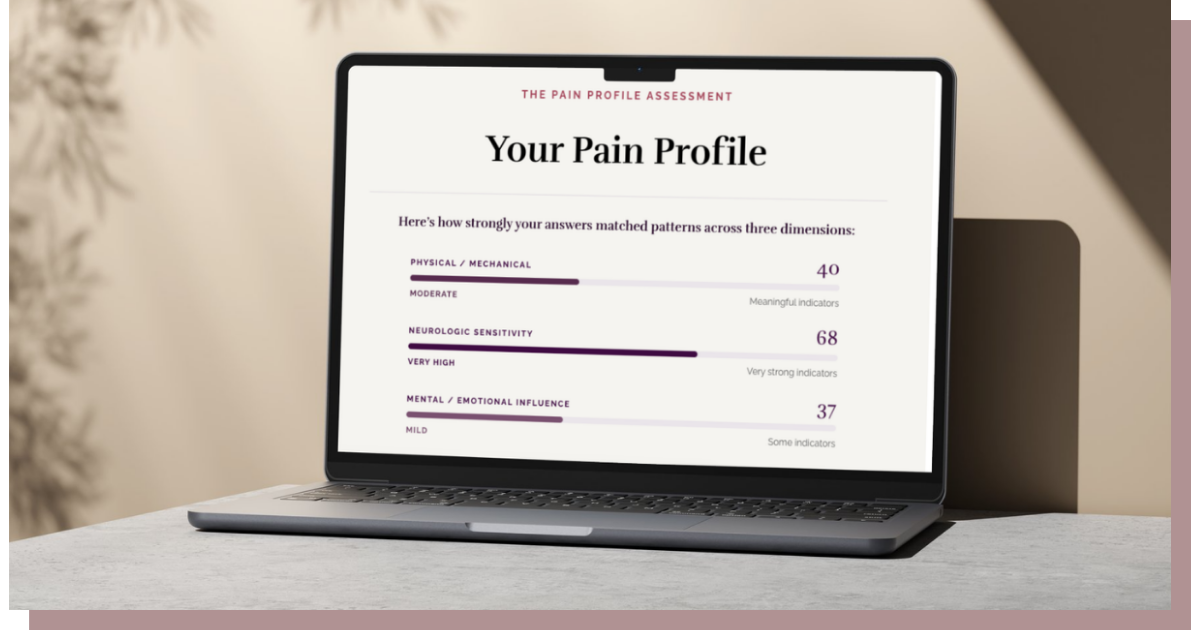
Not sure which dimension is driving your pain? Take the free Pain Profile quiz and get three separate scores: physical, neurologic sensitivity, and mental/emotional.
If neurologic sensitivity turns out to be the driver, that's exactly what The Uprising: Complex Pain Academy is built to address. It is the only structured program for people with complex and persistent pain that targets the neurologic system directly, not just the body or the mind. When you're ready to find out whether it's a fit, submit your free application here. I'll read it myself and let you know.