The Certainty Trap: You Don't Need a Diagnosis to Start Treating Chronic Pain
Waiting on a referral. Waiting on an MRI. Waiting on the specialist who might finally explain what's going on. If you have persistent pain without a clear diagnosis, waiting can start to feel like the treatment plan. I call this the certainty trap: the belief that you need a definitive answer before you're allowed to start getting better. Here's why that belief keeps so many people stuck, and why you can begin addressing your pain now, alongside your medical care.
Uncertainty Is Built Into Complex Pain
The road through persistent pain is full of uncertainty. Uncertainty about what's causing it. Uncertainty about which treatments to choose. Uncertainty about how long it will last, and how much worse it could get.
The level of uncertainty I see people carrying is, frankly, dangerous. Faced with that much of it, we crave control. That's human nature. We want clarity and confidence. We chase validation, proof and answers.
Many of the people I work with arrive exhausted. The pain is only part of it. The rest is the striving: striving for certainty.
For complex and persistent pain
Something is being missed.
The Uprising: Complex Pain Academy is a structured, 5-phase program that targets the neurologic sensitivity behind persistent pain, in the right order and at the right dose, with a specialist guiding every step.
What the Certainty Trap Looks Like
I recently coached a woman who was completely drained, weighed down by not knowing what was truly causing her pain. Without realizing it, she had decided that her body couldn't get better until she had a definitive explanation.
So what happens if that explanation never comes?
She keeps fighting to find the right doctors. She advocates for herself. She gets the tests, the scans and the appointments. And she still gets no straight answers, just vague and conflicting explanations. Then more waiting. More striving. No forward momentum.
That cycle is common. Months pass between a referral, the appointment, the imaging and the follow-up. Each step feels like progress, yet nothing about the pain itself has been addressed. Then the scan comes back clean. A clean scan is good news, and it also tends to restart the search: a new referral, a new specialist, another round of waiting.
This need for complete certainty keeps many people stuck.
Why 100% Certainty May Never Come
With persistent and complex pain, 100% certainty may not be possible.
Imaging and lab work are excellent at finding structural damage, disease and red flags. Ruling those out matters. But even a full battery of tests can't show the neurologic adaptations that so often keep pain going: changes in how signals are detected, processed and mapped between the body and the brain. Neurologic sensitivity doesn't light up on an MRI.
That's why so many people hear "everything looks normal" while their pain is anything but. The tests are answering the question they were designed to answer. The question that would explain the pain isn't one a scan can ask.
So if you're waiting to feel completely certain before moving forward, you may wait forever.
Meanwhile, time keeps passing. Every month in a holding pattern is a month with no forward momentum, and the next appointment rarely ends the pattern on its own.
The Medical System Has Medical Solutions
This is not an argument against medical care. Keep your appointments. Get the workup your doctors recommend. Ask good questions, and talk to your doctor with a clear, organized picture of your symptoms so every visit counts.
The medical system has medical solutions: diagnostics, medications, procedures, surgery when it's needed. That's its job, and it does it well. What it isn't set up to do is train a sensitive signaling system. That work falls outside most appointment slots, and it doesn't require a final diagnosis to begin.
Neurologic work can start now and run alongside everything else. Understanding why your pain behaves the way it does, recognizing your amplifiers, learning to push to it rather than through it: none of that has to wait for the next scan.
You Don't Need Permission to Start
You don't have to wait for permission to start getting better. You don't need all the answers to begin moving forward.
I know this isn't what most people want to hear, but it's true: you may need to be okay with some level of uncertainty. There are ways to move forward even when the path isn't entirely clear.
Certainty can come later. Some of it arrives through the work itself, as you learn what settles your pain and what amplifies it. That kind of clarity no scan can give you.
The difference between waiting and moving forward comes down to having a plan that doesn't depend on a final answer. A structured plan sets the order and the dose for your situation, adapts as you learn more, and keeps making progress while the medical side of your care continues.
No, it isn't easy. It is possible. And it's worth it. Don't let the need for certainty hold you back.
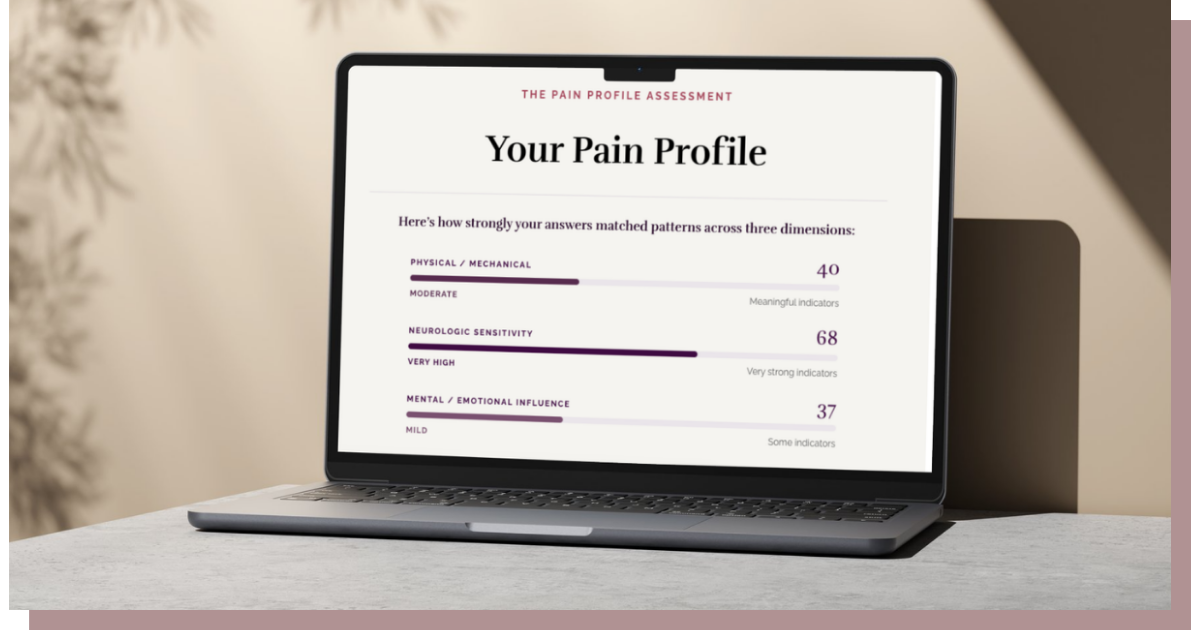
Not sure which dimension is driving your pain? Take the free Pain Profile quiz and get three separate scores: physical, neurologic sensitivity, and mental/emotional.
If neurologic sensitivity turns out to be the driver, that's exactly what The Uprising: Complex Pain Academy is built to address.