Tried Everything for Chronic Pain? Why Trying Harder Isn't Working
If you've tried everything for chronic pain, you probably haven't tried too little. Most of the people I work with have tried more than anyone around them realizes: physical therapy, manual therapy, medications, supplements, injections, calming practices, a shelf of books, and hours of research late at night. They aren't short on effort. They're short on a plan.
That distinction matters. When effort doesn't produce results, the natural response is to try harder. Add another tool. Read another article. Book another specialist. For people with complex pain, trying harder in that way is one of the most reliable ways to stay stuck. Here is why, and what actually moves things forward.
The Comment That Sums Up the Problem
I once woke up to a comment on one of my videos: "Let's just get to what to do about it already."
I've heard versions of that criticism for years. People want more tools, more practical steps, more things to try tonight. I understand the frustration. That comment also captures exactly what has gone wrong in the pain-relief world.
Doctors, friends, family, and the internet hand out scattered advice, random tools, and quick fixes. Then they leave you to figure out how the pieces fit together. Adding more random tools to that pile would only add to the clutter.
For complex and persistent pain
Something is being missed.
The Uprising: Complex Pain Academy is a structured, 5-phase program that targets the neurologic sensitivity behind persistent pain, in the right order and at the right dose, with a specialist guiding every step.
Collecting Tools Feels Like Progress
Searching for answers turns into a treasure hunt. Every new find, whether it's a supplement, a stretch, a video, or a device, delivers a small hit of dopamine whether or not it actually works. The feeling of discovery is real. The progress usually isn't.
Before long, the collection starts to look like the junk drawer in my kitchen. Some things in there are genuinely useful. Some I forgot I had. Some I couldn't tell you what they're for.
The pattern often becomes whack-a-mole. Pain spikes, so you add something new. A different area flares, so you add something else. Each tool gets a few days before the next spike sends you searching again. Nothing gets enough time or the right context to show what it can do, and nothing builds on what came before.
Why "Research Mode" Keeps You Stuck
Many of the women I work with are high achievers. They're used to being on top of everything, and when pain shows up, that mindset goes to work: "If I do everything perfectly, I'll fix this." They research every angle, try every treatment, and believe that if they aren't doing it all, they aren't doing enough.
That drive is a strength in most areas of life. With complex pain, it often works against you.
Research mode is a protective habit. It feels like taking control. It also keeps you scanning for the next threat and the next answer, and it pulls you in fifty directions at once. A system pulled in fifty directions doesn't get a clear, consistent signal in any of them.
You may already recognize how it feels. Immense pressure to get every step right. A constant fear of missing something. Exhaustion after pushing too hard. Guilt about taking a break. A sense that slowing down means falling behind.
And every time a new tool replaces the last one, progress resets. You start over at day one with something new, and the work that needed weeks of consistency never gets them.
Ingredients Without a Recipe
Think about baking a cake. You can have every ingredient for an award-winning cake sitting on the counter: flour, eggs, sugar, butter, baking powder, vanilla. Without the recipe, without knowing the combination, the order, the measurements, and the timing, those ingredients create a mess instead of a masterpiece.
That is what's happening in most pain care right now. Plenty of the tools out there have a decent track record. Physical therapy, manual therapy, medications, and calming practices all have a place. Whether a single tool works matters far less than how the tools connect.
Physical therapy can help one piece of the problem. If it isn't paired with work that addresses nerve sensitivity, or if the body isn't ready for that type of movement yet, it can backfire. Calming practices can feel powerful in the moment. Without work that directly reduces nerve sensitivity alongside them, they can feel like spinning your wheels.
Order matters as much as selection. The right tools used in the wrong order, or with the wrong strategy, can slow recovery or make things worse. And even the right tools fall short on their own. Complex pain has more than one driver, which is why lasting pain relief never comes from only one angle. One or two tools can't carry the whole load.
What Actually Moves Complex Pain Forward
Real progress comes from structure: an organized, complete plan that matches the tools to what your system needs right now. That plan answers five questions. Which tools fit your body at this stage. In what combination. In what order. In what amount. At what timing.
When people with neurologic sensitivity finally get that structure, the work often looks smaller than what they were doing before. Fewer things, done consistently, matched to where their system is today. Push to it, not through it.
That can feel too simple. It can feel too slow. People who are used to doing everything worry that doing less means giving up ground. Overactive pain pathways change through consistent, well-placed input over time. Sheer quantity of effort doesn't speed that up, and it often gets in the way.
This is also not the kind of work you try once or twice and abandon if you aren't better by tomorrow. We live in a culture of instant gratification, do-it-yourself everything, and oversimplified answers to complex problems. It creates the illusion that a few tools should solve our deepest problems quickly and completely. Complex pain doesn't follow that script. Real progress happens gradually, through consistent effort and strategy.
Stop Collecting. Start Connecting.
Everyone wants the lost treasure: the right doctor, the magic pill, the procedure, the treatment, the one tool that fixes everything. If you've been searching for it and you feel stuck, overwhelmed, or like you're missing a piece of the puzzle, that says nothing about your effort or your worth. No one has shown you how the pieces fit together yet.
That is the work I do with clients. I teach the theory, the strategy, and the framework, so they can build their own plan, understand why each piece is there, and eventually not need me at all. The tools matter. The recipe decides whether they work.
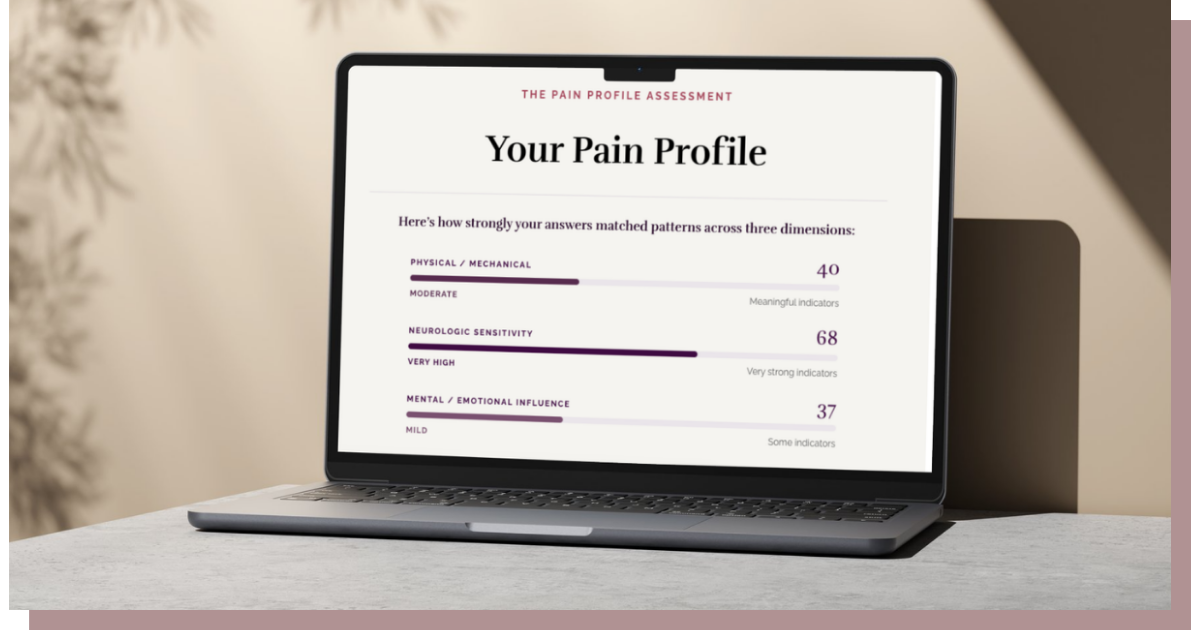
Not sure which dimension is driving your pain? Take the free Pain Profile quiz and get three separate scores: physical, neurologic sensitivity, and mental/emotional.
If neurologic sensitivity turns out to be the driver, that's exactly what The Uprising: Complex Pain Academy is built to address.