Why Stretching Doesn't Fix Tight Muscles in Chronic Pain
Your upper traps feel like rocks. Your back is tight, your hips are stiff, and the knots never fully release. You've stretched every day, tried foam rolling, massage, and every new "release" technique you've come across, and the tightness comes right back, sometimes within the hour.
If you've had chronic muscle tension for years, finding the right stretch won't solve it. Those muscles are tight for a reason, and stretching doesn't address that reason. Here's what's actually going on, and why chasing a better stretch keeps you stuck.
Why the Next Stretch Won't Be Different
When I worked in the clinic as a physical therapist, one of the most common questions I heard was: "Can you show me a stretch to relieve this pain?" My first response was always to ask what stretches the person had already tried. Then I'd get creative and teach them something new.
I could get very creative, and people enjoyed learning new ways to move. But eventually I grew frustrated with that process. For patients who had lived with pain for a long time, nothing I showed them was going to resolve their pain or tension. No new stretch, mobility drill, or exercise would be any different from the hundreds of things they'd already tried.
Stretching helped a little. It gave temporary relief, but only on the days they did it, and for some it had almost no effect at all. Nobody wants to spend an hour a day stretching just to take the edge off. That's not a long-term solution.
Today I see a steady stream of online coaches and clinicians demonstrating clever new stretches promising to fix back pain or neck tension. Early in my career I would have admired them. Now I see a narrative that keeps people searching for a magic movement that doesn't exist.
For complex and persistent pain
Something is being missed.
The Uprising: Complex Pain Academy is a structured, 5-phase program that targets the neurologic sensitivity behind persistent pain, in the right order and at the right dose, with a specialist guiding every step.
Chronic Tightness Is Protective Tone
Muscles that stay tight for months or years are being held tight by the nervous system.
When the system perceives threat, part of its protective response is to increase tension in the big muscle groups that move and brace the body: the upper traps, the hip flexors, the long muscles along the spine. Those muscles are primed and ready to protect you. In someone with persistent pain, that protective tone often stays on long after the original reason for it has passed.
The result is familiar to almost everyone with chronic pain:
- Muscles that feel sore, achy, stiff, and tight all at once.
- A strange combination of feeling tense and exhausted at the same time.
- Knots that don't release with even the most aggressive massage.
- Relief from stretching or massage that fades within hours.
That pattern makes sense once you see the tension as protection. The problem sits upstream of the tissue, in the signal telling it to guard.
Why Stretching Harder Can Increase Guarding
When stretching doesn't work, the instinct is to stretch longer, push deeper, or move on to more aggressive tools: rolling, digging into knots, scraping, pressing until it bruises.
But if the tightness is a protective response, forcing the muscle into a position the system is guarding sends one more signal that something is wrong. A sensitive system responds to that by guarding harder. You get a brief release followed by tension that returns just as strong, sometimes stronger, plus soreness from the treatment itself.
This is the same reason the principle push to it, not through it applies to flexibility. Forcing through resistance in a protective system tends to feed the protection you're trying to get rid of.
None of this means stretching is bad. Staying mobile and active matters, and I want people moving. The problem is expecting stretching to solve a problem it was never designed to address. You can't fully relieve that tension until you address what's telling those muscles to be so tense in the first place.
What Actually Reduces Chronic Muscle Tension
There's more to persistent pain and tension than what's happening in the muscles, joints, and discs. The tension is downstream of an overactive signaling system. To change the tension, you work with that system.
That means lowering neurologic sensitivity and reducing the amplifiers that keep the protective response switched on. Methods like pain neuroscience education, graded motor imagery, sensory discrimination, and neurodynamic techniques work at that level, giving the system reasons to stand down instead of fighting the muscles directly.
Once the protective response settles, stretching becomes far more effective. Flexibility and range of motion improve more readily when the system is no longer guarding against every movement. This is why strengthening and stretching belong later in the process, after sensitivity has started to settle, not as the opening move. Most programs start with stretching and strengthening. That's exactly why they stall, and it's a big part of why exercise makes chronic pain worse for so many people.
How these pieces are combined, what comes first, and how each is adjusted to the individual decides whether the system settles or flares. That's the work of a structured plan, and it's what keeps you from cycling through yet another collection of stretches.
Stop Searching for the Perfect Stretch
Keep moving. Stay as active as you can. But if you've spent years stretching to get a few hours of relief, a more creative stretch won't change the outcome. The answer lies deeper than the muscles, in the system that's holding them tight, and that's where the work needs to happen.
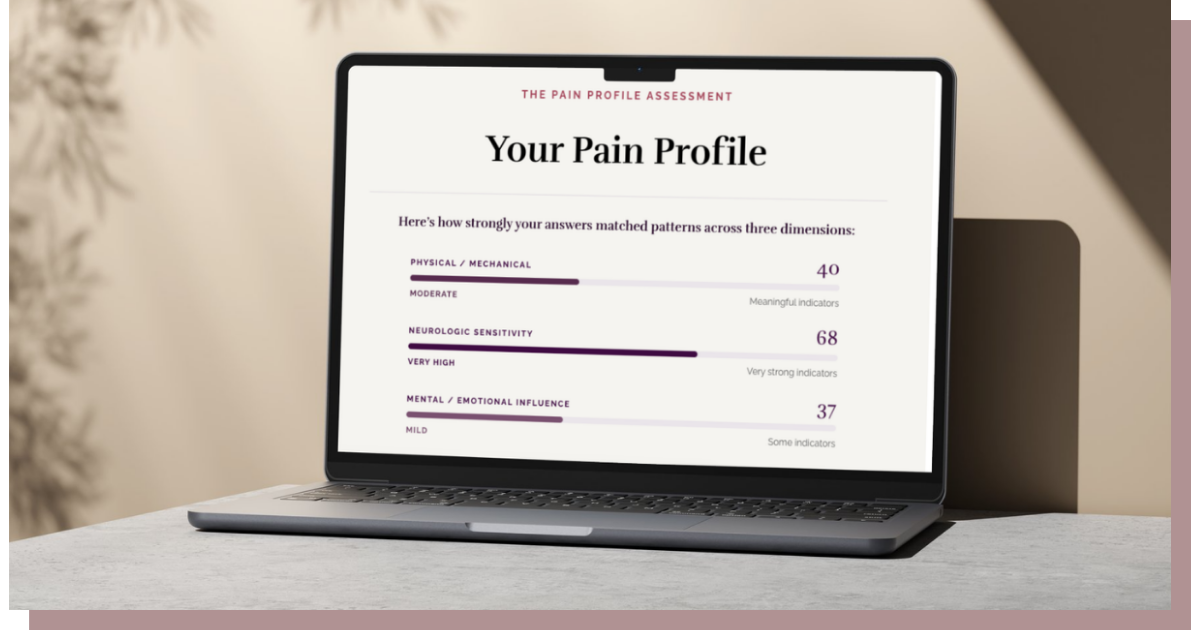
Not sure which dimension is driving your pain? Take the free Pain Profile quiz and get three separate scores: physical, neurologic sensitivity, and mental/emotional.
If neurologic sensitivity turns out to be the driver, that's exactly what The Uprising: Complex Pain Academy is built to address.