Why the 0–10 Pain Scale Fails Complex Pain (and How to Describe Your Pain to a Doctor)
"On a scale from 0 to 10, what is your pain?" If you live with complex or persistent pain, you have answered that question hundreds of times, and you have probably spent more energy on it than any one number deserves. The 0–10 pain scale is a fixture of every medical visit, yet it captures very little of what complex pain actually is. In this article I explain why the pain scale fails people with complex pain, and how to describe your pain to a doctor in a way that gives them useful information.
Why the Pain Scale Is So Hard to Answer
I have a strong opinion about the pain scale, and some of it comes from personal experience.
On the way to the ER once, I couldn't breathe. I was vomiting, shaking, groaning, and unable to find any position of comfort. And I asked my husband what he thought my pain level was, because I wanted to answer the question accurately. To me it was a 10. I doubted my own perception, because I was worried I would be judged for saying it out loud.
Many of you can relate. Others answer honestly with the first number that comes to mind and then find their integrity questioned. Exaggerating. Faking. Attention seeking. Drug seeking. I have heard countless stories of patients being dismissed or gaslit around that single number.
For complex and persistent pain
Something is being missed.
The Uprising: Complex Pain Academy is a structured, 5-phase program that targets the neurologic sensitivity behind persistent pain, in the right order and at the right dose, with a specialist guiding every step.
Six Reasons the 0–10 Pain Scale Fails Complex Pain
- It is subjective. The scale measures a personal experience with a number that looks objective. That makes it an unreliable tool for comparing one person to another.
- It ignores suffering. Pain intensity and the degree of suffering it causes are two different things. The scale only asks about one of them.
- There is no consistent standard. One provider's 7 is another provider's 4. One patient's 5 is another patient's 9. Without shared definitions, the numbers drift.
- Persistent pain behaves differently from acute pain. Pain from a fresh injury usually follows the injury. Complex pain is shaped largely by neurologic sensitivity, so intensity can swing with amplifiers that have little to do with the tissues. A single number misses that pattern.
- Repeated focus on intensity can amplify it. Attention on pain is one of the amplifiers in a sensitive system. Being asked to zero in on the number, visit after visit, does not help.
- It can't guide treatment on its own. A pain level is not sufficient to diagnose a problem or decide on a plan of care. It is still treated as a required part of nearly every visit.
The pain scale isn't going anywhere soon. So the practical question is how to work with it without letting it work against you.
How to Describe Your Pain to a Doctor
These are the points I share with clients who want to talk to their doctor about chronic pain and actually be heard.
Separate the physical pain from the degree of suffering
Be honest about your pain, and keep your answer on the scale. Saying your pain is an 11 or higher is an understandable attempt to communicate severity, and it tends to backfire. Many providers believe a 10 means you couldn't hold a normal conversation. They often don't realize how good people with persistent pain become at masking. When they ask for a number, they are usually asking about the physical intensity alone. The emotional toll of your pain matters a great deal. It just deserves its own conversation, separate from the number.
Ask what they actually want to know
When you are asked to rate your pain, it is fair to ask a clarifying question. "What information would be most helpful for planning my care?" Then get specific. Do they want your average pain across your whole body, or the pain in your shoulder? Your hip at rest, or while walking? Your back at its worst, or at baseline? Your hands during a flare, or right now? Your answers will vary, and you don't have to compress complex pain into one vague number. The more specific the question, the more accurate the number.
Be consistent from visit to visit
Every provider and every patient carries a slightly different definition of the scale. Providers use your numbers to judge whether you are improving, so consistency is what lets your real progress show up in the record. Bringing the same scale to every appointment, with a short definition for each number describing severity and how much it limits you, helps every provider read your numbers the same way.
Leave the number in the exam room
The 0–10 number exists for the medical visit. Outside of appointments, it does very little for you. Rating your pain intensity over and over keeps your attention on it, and intensity is the part of the experience you have the least direct influence over. What tells you far more about your progress is how sensitive your system is: how easily it reacts, and how quickly it settles. That is what I track with clients, because neurologic sensitivity is what we can actually change.
Your Pain Is More Than a Number
A single number was never designed to capture complex pain. Understanding why it falls short lets you answer the question with confidence, advocate for yourself without second-guessing, and keep your focus on what is actually driving your pain.
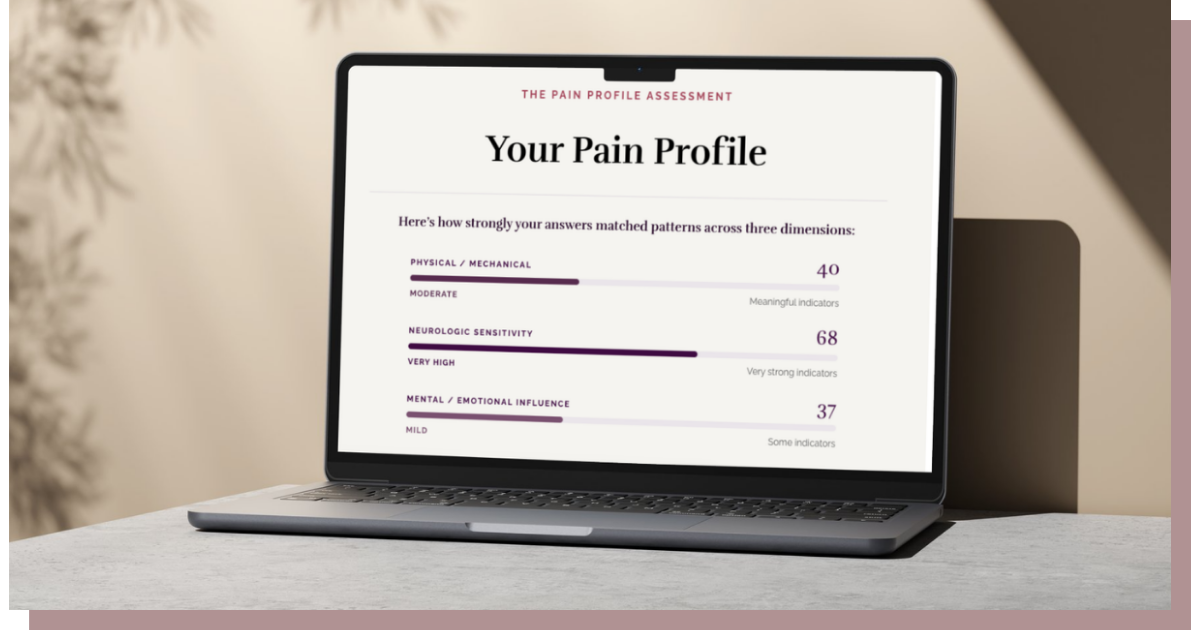
Not sure which dimension is driving your pain? Take the free Pain Profile quiz and get three separate scores: physical, neurologic sensitivity, and mental/emotional.
If neurologic sensitivity turns out to be the driver, that's exactly what The Uprising: Complex Pain Academy is built to address.