Will I Always Have Pain With CRPS? Why "Pain Forever" and "Can't Get Better" Are Different Claims
"You're going to be in pain forever." If you have Complex Regional Pain Syndrome, there's a good chance a doctor has said some version of that sentence to you. It usually arrives alongside "there's no treatment" or "there's nothing more we can do," and it lands like a verdict. I want to take that sentence apart, because it's actually two separate claims wearing one coat. One of them is sometimes true. The other almost never is. The difference between them changed one woman's life after ten years of CRPS, and it matters for yours.
Two Claims That Sound the Same and Aren't
When a clinician says "you'll always have pain," they are making a claim about a cure. Will the pain ever be fully gone? With CRPS, especially long-standing CRPS, I can't promise that. Nobody honest can.
But that sentence gets heard as something very different: "You can't get better." That is a claim about trajectory. About function. About whether anything in your life can change from here. And that claim is not supported by the evidence. I've watched too many people with CRPS improve significantly to accept it.
"There's nothing more we can do" is not an evidence-based statement. It's a statement about the limits of what one clinic offers, delivered as if it were a statement about your biology.
There may not be a cure. That does not mean it can't get better. Hold onto that distinction, because it's the whole spine of this story.
A Decade of CRPS and the Smallest Possible Goal
The woman I'm thinking of was in her mid-forties when we met. She had lived with CRPS for about ten years. By then she had been through multiple knee surgeries and a joint replacement, and her signaling system had become so sensitive that flare-ups could be set off by almost anything: sleeping in the "wrong" position, the smallest activity, even wearing the wrong pair of pants.
When I asked about her goals, she said this: "My big wild scary goal is to be able to walk my dog. It's the most desperate, smallest goal."
Think about that. A decade of effort, surgery after surgery, and the most she dared to hope for was a walk around the block with her dog. That's what "you'll be in pain forever" does to a person's imagination. It doesn't just describe the pain. It shrinks the future.
Somewhere along the way, a doctor had told her exactly that. No treatment. Pain forever. She believed it, because what else was she supposed to do with it?
What Happened When We Treated the Signaling System
CRPS is not an orthopedic problem that refuses to heal. It is a condition in which the sensory signaling system itself, the nerves and pathways that detect, transmit, process, and respond to information, has become unusually sensitive and reactive. That is neurologic sensitivity, and it needs to be treated as its own category.
So that's what we did. Not more strengthening. Not another injection. Pain neuroscience education so she understood what was actually happening in her body. The graded motor imagery sequence, in the right order. Sensory discrimination work. Pacing adapted for a system that overreacts, built around "push to it, not through it." The physical rebuilding came later, once the system could tolerate it.
For ten years she had been certain she would spend the rest of her life with pain that only got worse. So when she started having moments, and then whole days, with little to no pain, she was shocked. She described it like stepping off a rollercoaster, or stepping onto land after a full day on a boat. Her brain had been so accustomed to the pain that its absence felt strange.
The first time it really let up, she said, "Oh my goodness, my pain is ending."
Better Did Not Mean Less Pain on Her Worst Days
Here is the part I refuse to skip, because it's the honest part and it's the useful part.
When we measured her progress, the degree to which pain interfered with her daily life was roughly cut in half. Her depression scores dropped to near zero. Her pain-related fear and stress improved dramatically. Her tolerance for activity more than doubled. Even her brain fog eased substantially.
And yes, she met her wild, scary goal. She walks her dog whenever she wants to now.
But her worst-day pain number barely moved. Her hardest days are still hard days.
Read those two paragraphs together, because they are the entire point. If "better" only means "less pain on the worst day," she didn't get better. If "better" means her life opened back up, her mood recovered, her fear let go of her, and she could do more than twice what she could do before, she got dramatically better. The doctor who told her "pain forever" may have been technically right about the worst days. He was completely wrong about everything else.
That's the trap in the two claims. "You will always have pain" gets used as a reason not to treat, when it says nothing at all about whether treatment can change your life.
When She Stopped Searching
For all those years she was convinced the answer was waiting somewhere in her medical care, and she was determined to find it. More surgeries. More injections. Conversations about spinal cord stimulators.
A few months into working together, she told me she was done searching. Not in defeat. In relief. She said she finally felt a sense of peace, because she no longer had to keep going back to a system that hadn't offered her anything that helped. She could stop looking and start moving forward.
You could practically see the weight come off her shoulders. She wasn't waiting anymore for something the medical system was never going to hand her.
Why This Matters If You Have CRPS
I share this because so many women with CRPS are stuck in the same loop. They are relying on a system that hasn't caught up with the research on what actually works for this condition, and that system keeps saying "there's no treatment" because it's describing its own toolbox, not your potential.
Three things I want you to take from her story:
- A long history does not close the window. Ten years of CRPS, multiple surgeries, and a joint replacement did not make her signaling system untrainable.
- Function, mood, fear, and tolerance can change substantially even when the worst-day pain number is stubborn. Those changes are not consolation prizes. They are the life you get back.
- The treatment that moved the needle was aimed at neurologic sensitivity directly, not at the knee yet again.
I won't tell you it will go for you exactly the way it went for her. I will tell you she spent ten years being told there was nothing, and there was something. If you want to understand the mechanism behind this kind of change, start with my CRPS series, and if you've been told your window closed, read why a sensitized signaling system is still a trainable one.
Separate the Two Claims and Make Your Own Decision
The next time someone tells you "you'll always have pain," ask them which claim they're making. If they mean there's no cure, you can accept that and keep going, because it has nothing to do with whether you can get better. If they mean nothing can change, ask for the evidence. There isn't any.
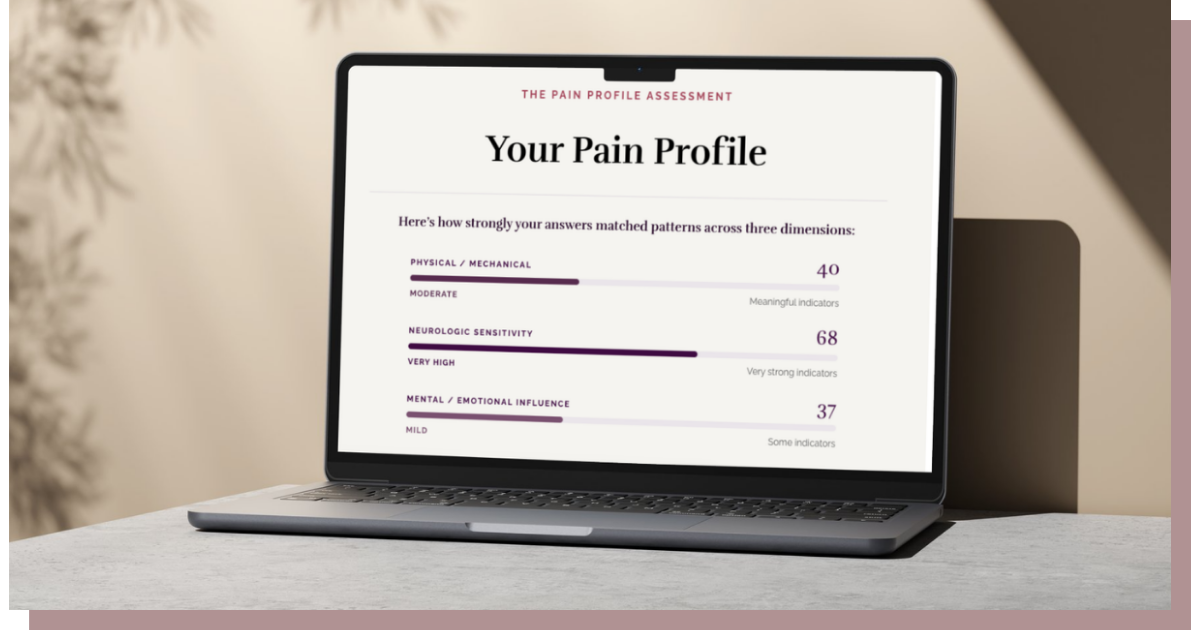
Not sure which dimension is driving your pain? Take the free Pain Profile quiz and get three separate scores: physical, neurologic sensitivity, and mental/emotional.
If neurologic sensitivity turns out to be the driver, that's exactly what The Uprising: Complex Pain Academy is built to address. It's the something she found after a decade of being told there was nothing.