Allodynia: Why Light Touch Hurts With Fibromyalgia and Chronic Pain
If a hug, a bedsheet, a waistband, or a hand on your shoulder hurts, there is a name for it: allodynia. Allodynia is pain from a touch or sensation that shouldn't be painful. It shows up in fibromyalgia, widespread pain, nerve-related pain, and many other complex pain conditions, and it's one of the symptoms people hide most, because it sounds strange to say out loud. It has a clear neurologic explanation, and it can change.
"I Love Hugs. Now I Dread Them."
On one of our group calls, a woman in our community finally said it: "I love hugs. I'm a total hugger. But now I dread them. You're probably going to think I'm weird or crazy, but touch has become painful."
She was embarrassed and worried about what everyone would think. Instead of judgment, the other women began chiming in, one after another. "Oh my gosh, me too." "I thought I was the only one." "I've never told anyone that before."
She had carried this quietly for years. She was afraid to mention it to her doctors because she worried they'd think she was exaggerating. And it was costing her at home too. Her husband shows love through physical touch, and pulling away from hugs had left them both feeling disconnected.
If touch has become painful for you, you are not alone, and it isn't strange. It's far more common than most people realize.
For complex and persistent pain
Something is being missed.
The Uprising: Complex Pain Academy is a structured, 5-phase program that targets the neurologic sensitivity behind persistent pain, in the right order and at the right dose, with a specialist guiding every step.
What Allodynia Is
Allodynia means a normally non-painful stimulus produces pain. Light touch, the brush of clothing, gentle pressure, or a change in temperature registers as pain even though nothing harmful is happening to the skin or tissue underneath.
That is different from tenderness over an injured spot. A bruise hurts to press because the tissue is injured. With allodynia, the tissue is fine. What has changed is how the signal is processed.
A related term is hyperalgesia, where something that is mildly painful feels far more painful than it should. The two often show up together in people with neurologic sensitivity.
Why Light Touch Registers as Pain
Every touch sends information from your skin through your nerves to your brain, which decides what that information means. Normally, a hug gets sorted as pressure and warmth. Nothing about it calls for protection.
With neurologic sensitivity, that sorting process changes. Overactive pain pathways respond to less input, and the protective response gets involved in signals that used to pass through as ordinary touch. The message arriving from the skin is the same. The interpretation is different.
Part of what drives this is smudging. Your brain keeps detailed maps of your body, and those maps let it tell exactly where a touch is and what kind of touch it is. With persistent pain, those maps can blur. When the brain can't read a sensation clearly, it leans toward protection. Uncertain information gets treated as a possible threat, and threat produces pain.
These are real neurological adaptations. They aren't imagined, and they aren't a sign that something is being damaged every time you're touched.
Why It Shows Up in Fibromyalgia and Widespread Pain
In conditions like fibromyalgia, sensitivity isn't confined to one injured limb. It can be spread across many areas of the body, so touch sensitivity can show up anywhere: a bra strap, clothing seams, a pat on the back, a massage that used to feel wonderful, a partner's arm across you in bed.
Because it doesn't match any visible injury, it's easy to dismiss, and many people learn to stop mentioning it. That silence costs a lot. It cuts people off from the people they love, and it leaves an important clue out of the conversation with their care team. Allodynia is one of several unusual symptoms that point to neurologic sensitivity, and it belongs in that conversation.
Why Toughing It Out and Avoiding Touch Both Fall Short
Most people with allodynia land in one of two places.
Some try to toughen up. They push through painful touch, or they're told to rub rougher and rougher textures on the area until it stops hurting. Pushing through confirms to the system that touch is a threat, which tends to keep the sensitivity high.
Others avoid touch altogether. They pull away from hugs, choose clothing around what hurts least, and guard the sensitive areas. That's an understandable response, and it also gives the brain less clear information about that part of the body, which leaves the smudged map smudged.
Neither path targets the actual change. Both are about tolerating or escaping the signal. The goal is a signaling system that reads touch accurately again.
What Targets Allodynia: Sensory Discrimination
Sensory discrimination is training the brain to identify and tell apart sensations accurately: where a touch is, and what kind of touch it is. It's a skill built through focused attention on the sensation, which is very different from desensitization, where the goal is simply to tolerate more.
Here is why it matters for allodynia. When the brain's map of an area sharpens, sensations come through clearly instead of as noise. Clear information needs less protection. As the system reads touch more accurately, the protective response has less reason to step in.
Sensory discrimination works best as part of a broader plan, alongside pain neuroscience education and graded motor imagery, with activity paced to where the system is. The dose, the order, and the individual adjustments decide whether it helps or flares. Done too hard or too early, any sensory work can backfire. Done in the right place in a structured plan, it is one of the most direct ways to address touch sensitivity.
You're Not Imagining It
If you've been hiding this, or you've thought "no one would understand," I want you to hear this plainly. I understand. There is a whole community of women who get it too. Touch that hurts is a real, explainable, neurologic adaptation, and adaptations can change with the right training.
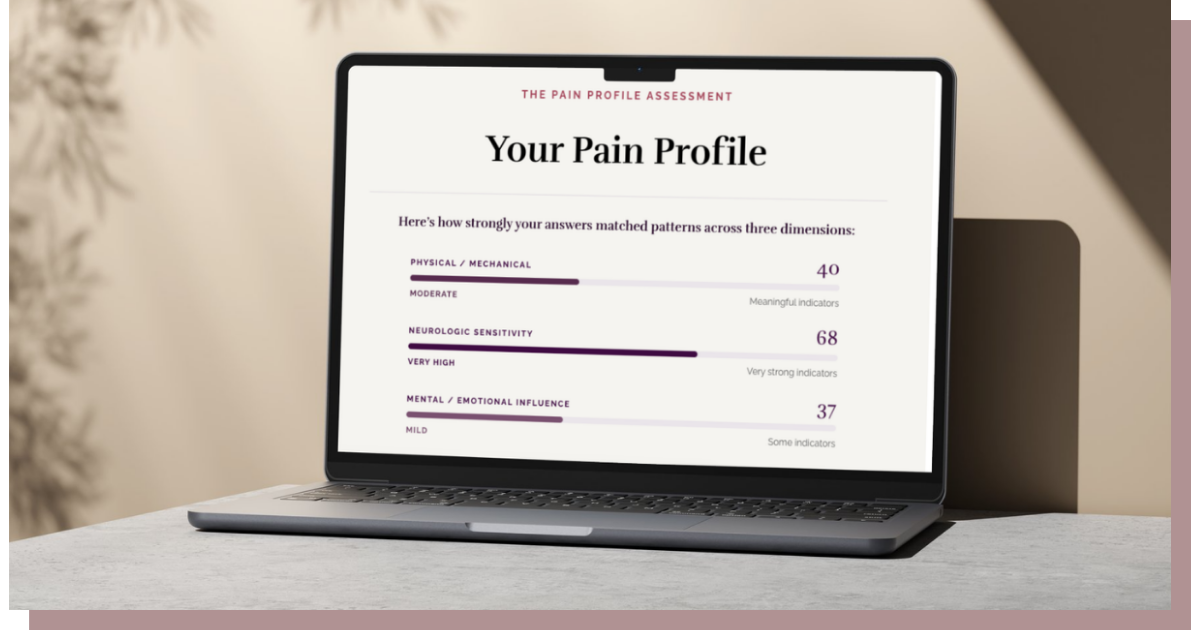
Not sure which dimension is driving your pain? Take the free Pain Profile quiz and get three separate scores: physical, neurologic sensitivity, and mental/emotional.
If neurologic sensitivity turns out to be the driver, that's exactly what The Uprising: Complex Pain Academy is built to address.