Can CRPS Improve After 20 or 30 Years? What Long-Term CRPS Recovery Really Looks Like
If you've had Complex Regional Pain Syndrome for years, you've read the line about early intervention. The first six months are critical. Act fast or lose the window. It shows up in nearly every article about CRPS, and it carries a message that nobody says out loud but everyone with long-standing CRPS hears: after six months, your system can't change. I've spent more than a decade working with people who are two, eight, eleven, and thirty years past that mark. I want to show you why the six-month verdict is wrong.
The Six-Month Window Myth
Early intervention matters. I'll say that plainly, because it's true. The sooner a strategic neurologic approach begins, the less time the signaling system has to settle into its new pattern, and the less guarding, disuse, and fear accumulate on top of it.
But "earlier is better" is not the same as "later is hopeless." Those are two different claims, and the research only supports the first one. Somewhere along the way, a statement about timing got turned into a statement about capacity. People who spent their first six months still fighting for a diagnosis were quietly told their chance had passed. People who are years in stopped asking whether anything could change.
Here's what the six-month story leaves out. The thing that changed in CRPS is the function of the sensory signaling system: the nerves and pathways that detect, transmit, process, and respond to information became unusually sensitive and reactive. That system is biological. Biological systems adapt in response to training, and they do not stop adapting at a calendar date. A system that adapted in one direction can adapt again. I explain the mechanism in Is Your Nervous System Hypersensitive?
I could leave it there and simply tell you that's not how the system works. I'd rather show you.
Three Women, More Than 80 Years of CRPS Between Them
These are three clients I've worked with. I've left out their names and rounded their numbers, because the point is not any one of them. The point is that none of them should have been able to improve according to the six-month story, and all three did.
Thirty-one years of CRPS that spread full-body
The first had lived with CRPS for about three decades. What started in one limb had spread throughout her body. She came in expecting very little, and she was surprised by how much more she could do once the work was structured.
Her tolerance for activity roughly doubled, from being able to manage well under half of what she wanted to do, to most of it. The degree to which pain interfered with her life dropped by about half. Her pain at its best went from a persistent moderate level down to almost nothing. Flare-ups that once lasted months now resolve in weeks. In her words, she's stronger overall, with greater range of motion than she's had in years.
Twenty-six years of pushing through
The second had CRPS for more than a quarter century. Pushing through pain was her operating mode. She'd been doing it so long it felt like discipline, and unlearning it was genuinely hard for her.
When she started to push to it instead of through it, things began to shift. Her activity tolerance more than tripled from a very low starting point. Brain fog that she'd rated as severe dropped to barely there. Her sleep quality more than doubled. For a long time it had felt like her system was simply stuck. After 26 years, it was still capable of changing.
Twenty-seven years of full-body spasms
The third had full-body CRPS for 27 years. Her most limiting symptom was spasms: locking so intense that it kept her from sleeping, and sometimes so severe that she needed someone else to help her body release.
Her sleep quality went from very poor to good. Her activity tolerance improved meaningfully. Anxiety dropped by about half, and her depression scores dropped to near zero. The degree to which pain interfered with daily life fell by roughly a third. The spasms became less frequent and less intense. She told me the exercises and drills put her back in the driver's seat.
What Did Not Change
I'm not pretending their symptoms disappeared. They didn't.
Not every measure moved. The first woman's pain at its worst came down, but it is still well above where anyone would want it. Some scores across the three of them barely budged. Flares still happen. Spasms still happen, less often and less intensely, but they have not vanished. None of these women would tell you they are cured, and I would correct anyone who said so on their behalf.
I'm telling you this because the honest version is more useful than the inspiring one. If you've had CRPS for decades, you don't need someone promising you a miracle. You need to know what is realistically still available to you. And what's available is this: becoming stronger, more active, and less limited by pain. Sleeping better. Thinking more clearly. Having your flares last weeks instead of months. Having pain take up less space in your life.
"No Cure" Does Not Mean Nothing Can Change
This is the spine of the whole conversation, so let me put it as directly as I can.
"There is no cure for CRPS" is a statement about whether a single intervention can make the condition disappear. It is not a statement about whether your symptoms can improve, your function can expand, or your signaling system can adapt. Those are different questions. The answer to the first is currently no. The answer to the others, in my experience with hundreds of people with CRPS, is consistently yes.
Somewhere, "no cure" became "nothing can be done," and "early intervention matters" became "your window closed." Neither of those translations is evidence-based. "There's nothing more we can do" is not an evidence-based statement. It describes the limit of one approach, not the limit of your biology.
If a woman with 31 years of full-body CRPS can become stronger, more active, and less limited by pain, and a woman with 26 years can start sleeping and thinking clearly again, and a woman with 27 years can take back control of spasms that had dictated her life, then the six-month verdict does not hold. Your system is still capable of change.
What Made the Difference After Decades
None of these women got better by trying harder at what they'd already tried. They got better by changing the approach.
- Working directly on neurologic sensitivity, with sensory discrimination and graded motor imagery introduced in sequence, instead of treating the limb as if the problem were only mechanical.
- Replacing "push through" with "push to it, not through it," so activity trained the system instead of provoking it. I explain why this matters in Why Exercise Makes Chronic Pain Worse.
- Dosing strength and mobility work to where each of them actually was, and progressing based on how their systems responded.
- Having a plan for flares, so a bad week became information instead of evidence that nothing would ever change.
After decades of guarding and disuse, the physical picture is more complicated, and the plan has to account for more. That's a reason for a more careful plan. It is not a reason for no plan.
There Is No Time Limit on This Work
One of these women said it better than I can: there is no time limit on healing. It may not be a cure. But having pain take up less space in your life after 26, 27, or 31 years still counts.
So I don't care whether you're inside the "early window" or decades past it. If you want help working directly on neurologic sensitivity and making progress from where you are right now, that's exactly what The Uprising: Complex Pain Academy is built for. You can start your application here. Applying doesn't commit you to anything; it's how we find out whether it's a fit.
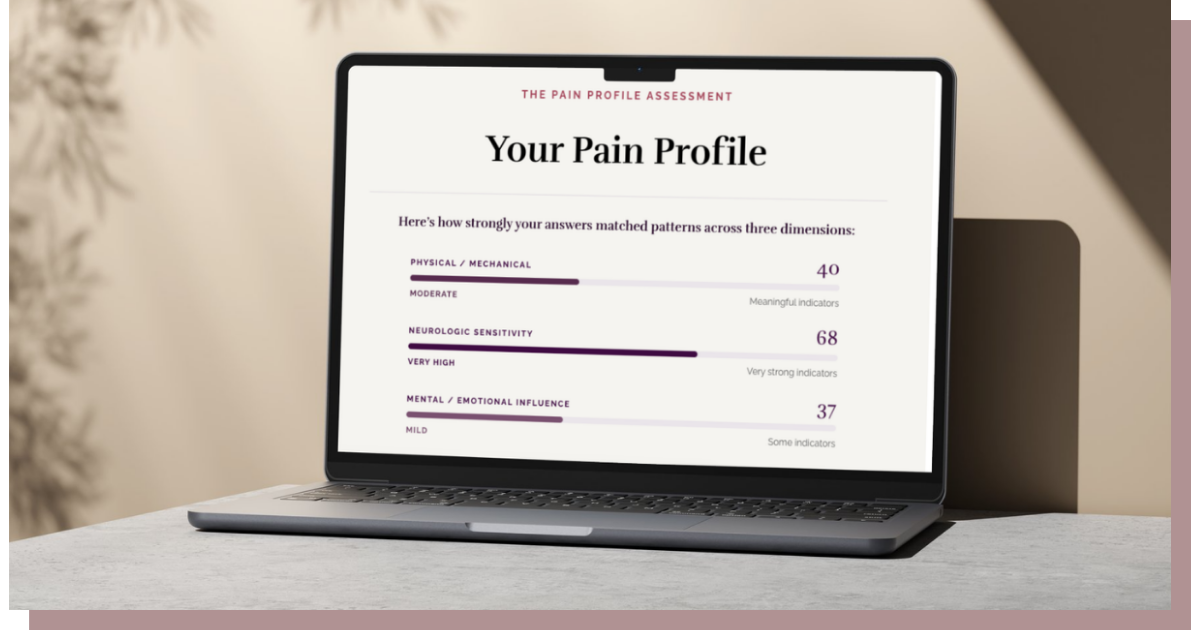
Not sure which dimension is driving your pain? Take the free Pain Profile quiz and get three separate scores: physical, neurologic sensitivity, and mental/emotional.
If neurologic sensitivity turns out to be the driver, that's exactly what The Uprising: Complex Pain Academy is built to address, whether you were diagnosed six months ago or thirty years ago.