Is the CRPS 'Cold Stage' Permanent? What the Research Actually Says
Whether you were diagnosed with Complex Regional Pain Syndrome last month or you've been living with it for over a decade, you've probably heard the same story on repeat: CRPS starts in a "warm stage" and then progresses into a "cold stage." And once things turn cold, there's no turning back. I want to take that story apart, because the newest research doesn't support it, and neither does what I see treating this condition.
Where the "Cold Stage of No Return" Story Comes From
The older model of CRPS described a predictable sequence. First the limb is warm, red, and swollen. Later it turns cold, blue or mottled, and the skin, nails, and muscles begin to change. The cold presentation was treated as the end of the line: the point where the condition had "set in" and treatment stopped working.
That model got repeated in textbooks, in clinics, and in every CRPS forum on the internet. For many people, it became a looming threat. Some have already been told they're "in the cold stage." Others have spent years watching their limb for the first sign of it.
Either way, it gets treated like a dead end. And that's the part I need you to hear clearly: the dead-end story is outdated.
What the Research Actually Shows About CRPS Stages
When researchers looked carefully at large groups of people with CRPS, the neat warm-then-cold progression didn't hold up. Instead, they found something closer to subtypes: some people present warm, some present cold, and the cold presentation does not reliably mean the person has had CRPS longer or that their condition has "advanced." People can be cold early. People can stay warm for years. Temperature and color can fluctuate in the same person depending on the day, the activity, and the environment.
In other words, "cold" describes a presentation, not a verdict. It tells you something about how the limb is currently regulating blood flow. It does not tell you that your system has lost its capacity to change.
The problem is that a lot of people living with CRPS have never been told that. Including many doctors.
What a Cold Limb Actually Means Neurologically
Here's the mechanism, briefly. The same signaling system that processes sensation in the limb also influences blood flow, sweating, and temperature regulation there. In CRPS that system has become unusually sensitive and reactive. When its output tilts one way, the limb runs warm and swollen. When it tilts the other way, blood vessels constrict and the limb runs cold, pale, or mottled.
Both presentations are expressions of the same underlying problem: neurologic sensitivity and a protective response that's working overtime. Neither one is the "real" CRPS. Neither one is a locked door.
This matters because the thing we train in a neurologic approach is not the temperature. It's the signaling system. And a sensitized signaling system is a trainable one whether the limb is warm or cold.
What Still Changes When CRPS Presents Cold
I work with people who've had CRPS for two years, eight years, and more than thirty years. Many of them present cold. Here is what I still see change when the work is structured well:
- Tolerance for touch, pressure, and movement increases as sensory discrimination and graded motor imagery improve the accuracy of the system's map of the limb.
- Activity capacity grows when strength and weight-bearing are dosed to the system, not to a protocol.
- Flares become shorter and less intense once people learn to push to it rather than through it.
- Sleep, brain fog, and the fear surrounding movement improve as the system stops treating every input as a threat.
- Function returns in ways that matter: socks, shoes, stairs, work, a full day on your feet.
Does the temperature always normalize? Not always. I'm not promising a cure, and I'm not going to tell you a cold limb will reliably turn warm. What I'm telling you is that the cold presentation does not prevent the signaling system from adapting. Pain taking up less space in your life still counts, and it is still available.
Why This Should Make You Hopeful, Not Afraid
If you've been watching your limb for signs of "turning cold" and bracing for the worst, you've been carrying a fear that the science doesn't support. If you've been told you're already in the cold stage and there's nothing more to do, you were given a statement that isn't evidence-based.
"There's nothing more we can do" is not an evidence-based statement. It's an admission that the standard approach has run out of ideas. A neurologic approach hasn't.
I walk through the mechanics of how CRPS behaves, which treatments help versus cost you later, and what you can actually do about it in my three-part CRPS series. If you want the broader picture of how a sensitized system changes, start with Is Your Nervous System Hypersensitive?
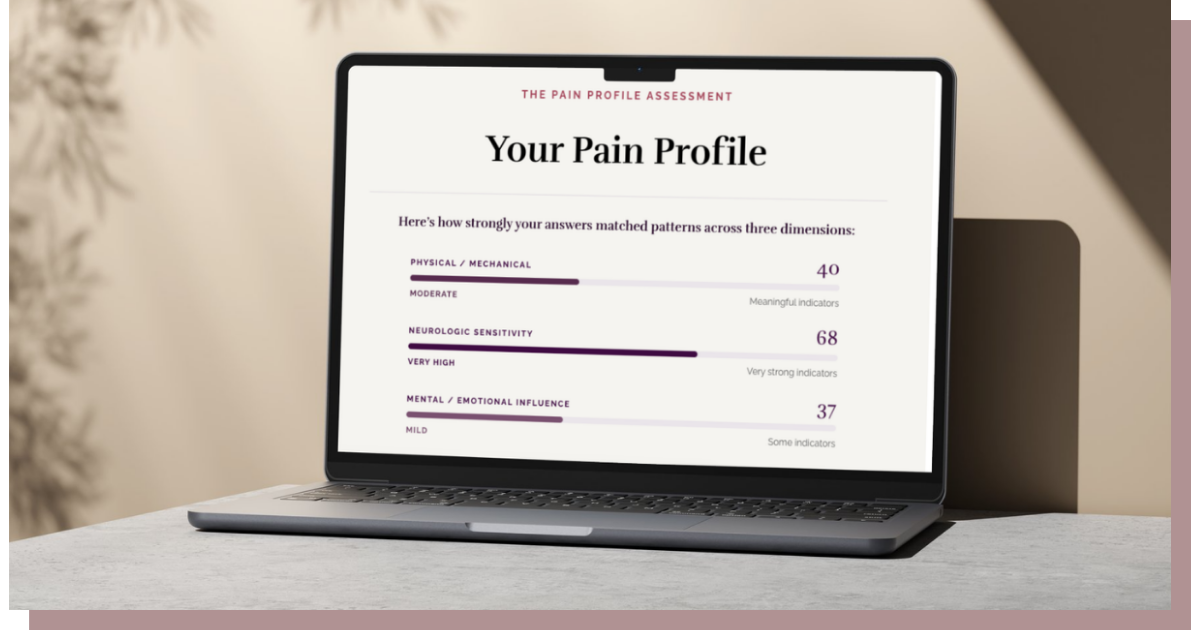
Not sure which dimension is driving your pain? Take the free Pain Profile quiz and get three separate scores: physical, neurologic sensitivity, and mental/emotional.
If neurologic sensitivity turns out to be the driver, that's exactly what The Uprising: Complex Pain Academy is built to address, whether your limb runs warm, cold, or both in the same week.