"There Is No Cure for CRPS" Is a Prognosis, Not a Treatment Plan: A Wrist CRPS Case Study
Getting a CRPS diagnosis is supposed to be the moment things start making sense. For most people, it's the moment they get handed a name, a grim prognosis, and nothing else. If you've been told "there is no cure, we can try injections" and then sent home to figure out the rest, this post is for you. A Complex Regional Pain Syndrome diagnosis without a plan is not a treatment. It's a label. And a label is not the same as a way forward.
What a CRPS Diagnosis Without a Plan Looks Like
Let me describe a client. She was in her late 60s, running a small business that depended on her hands: sewing, packaging orders, getting through an ordinary workday. About a year before I met her, she'd fallen badly and fractured her wrist. After surgery, the pain didn't follow the timeline everyone expected. It burned. The hand swelled and changed color. Things that should have been simple became unbearable.
Eventually she was diagnosed with CRPS, a condition that, in her words, nobody around her had even heard of. When she asked what she could do about it, the answer was essentially: there is no cure, and we can try injections.
No hope. No plan. She told me it felt like being treated like a guinea pig. She was crying at her desk most mornings because of the pain, and because nobody could tell her what to do about it.
I hear this story in slightly different forms constantly. The details change. The structure doesn't. A diagnosis arrives, a prognosis gets attached to it, and the person is left to carry both with no instructions.
Why "There Is No Cure" Is Not a Plan
I want to be precise here, because the phrasing matters. "There is no cure for CRPS" is a statement about one thing: whether a single intervention can make the condition disappear. It is not a statement about whether your symptoms can improve, whether your function can return, or whether your signaling system can change. Those are completely different questions, and they have different answers.
"There's nothing more we can do" is not an evidence-based statement. It describes the limits of one approach. The standard approach to CRPS is largely built around managing symptoms from the outside: medication to dull the signal, blocks and injections to interrupt it, and physical therapy that often pushes a reactive system harder than it can tolerate. When those run out, the conversation ends.
That is where the plan stops for most people. It is not where the biology stops.
What Is Actually Happening in CRPS
CRPS usually starts with something very physical: a fracture, a surgery, a sprain, a nerve injury. The tissue may heal. The signaling system does not automatically go back to how it was.
The nerves and pathways responsible for detecting, transmitting, processing, and responding to information become unusually sensitive and reactive. Light touch registers as threat. Movement that should be neutral provokes burning. The same pathways influence blood flow, sweating, and inflammation in the limb, which is why the hand or foot swells, changes color, and shifts temperature. This is neurologic sensitivity. It is a real, physical change in how the system functions, even though no scan shows it.
And here is the part the "no cure" conversation leaves out: a system that adapted in one direction can adapt again. Neurologic pathways respond to training. That capacity does not vanish because a diagnosis was given, and it does not vanish because a year has passed. I go deeper on this in Is Your Nervous System Hypersensitive?
What My Client Was Actually Looking For
When I met her, she wasn't looking for another painkiller. She'd been offered plenty of those. She was looking for something she could actually do.
She wanted structure. She wanted guidance from someone who had real experience treating CRPS, not someone who had read about it once. And she wanted to rebuild the use of her hand without flaring her symptoms and constantly overwhelming her system in the process.
That last part is the piece most CRPS plans get wrong. People are told to rest and protect, or they are told to push through. Neither one trains the signaling system. Rest leaves the sensitivity untouched. Pushing through pours input into a system that is already overreacting and teaches it to react harder. What she needed was a third option: a sequence of neurologic skills and physical drills, introduced in the right order, at a dose her system could tolerate, and progressed based on how it responded.
What Changed When She Had a Process
We built the plan in layers. First the groundwork: understanding what was driving her symptoms and learning how to adjust activity so a workday didn't cost her the next three. Then the neurologic training, one piece at a time. Sensory discrimination to help her system locate and distinguish non-painful input accurately. Graded motor imagery in sequence, starting with the least provocative steps. Strength and mobility work for the wrist dosed to where she actually was, not where a protocol said she should be.
Over the following months, her picture changed:
- She came off the pain medication she'd been relying on.
- She was sleeping several more hours a night.
- The degree to which pain interfered with her work and daily life dropped by more than half.
- The anxiety and fear wrapped around every movement of her hand faded.
I'm not describing a disappearance of CRPS. I'm describing a woman who went from crying at her desk to running her business with her hands again. She became more confident, and the reason was simple: she finally had a process for knowing what to do. When symptoms spiked, she had a next step instead of a spiral.
Why Having a Process Matters More Than Having a Prognosis
A prognosis tells you what someone expects to happen to you. A process tells you what to do tomorrow morning. People with CRPS are drowning in the first and starved for the second.
The difference shows up everywhere. Without a process, every flare feels like evidence that the prognosis was right. With a process, a flare becomes information: too much input, wrong order, time to adjust the dose. Without a process, you add treatments on top of treatments hoping one of them sticks. With a process, you introduce one thing at a time so you can tell what's helping. I lay out how I think about flares in How to Handle a Flare-Up.
The standard of care for complex pain is sub-standard care. Not because the clinicians involved don't care, but because most of them see one or two CRPS cases a year, and that is not enough to learn the nuances. A diagnosis without a plan is what that gap produces.
You Don't Need to Piece This Together Alone
If you've been handed a CRPS diagnosis and a shrug, you are not out of options. You were given an incomplete conversation. The part that was missing is a structured, step-by-step process for working directly on neurologic sensitivity, with the right skills and drills, introduced in the right order, at a dose your system can actually tolerate.
That is exactly what The Uprising: Complex Pain Academy is built to provide. It grew out of more than a decade of working almost entirely with complex pain and hundreds of people with CRPS. If you want to find out whether it's a fit, start your application here. Applying doesn't commit you to anything. It's a way to find out whether this is the right next step for you.
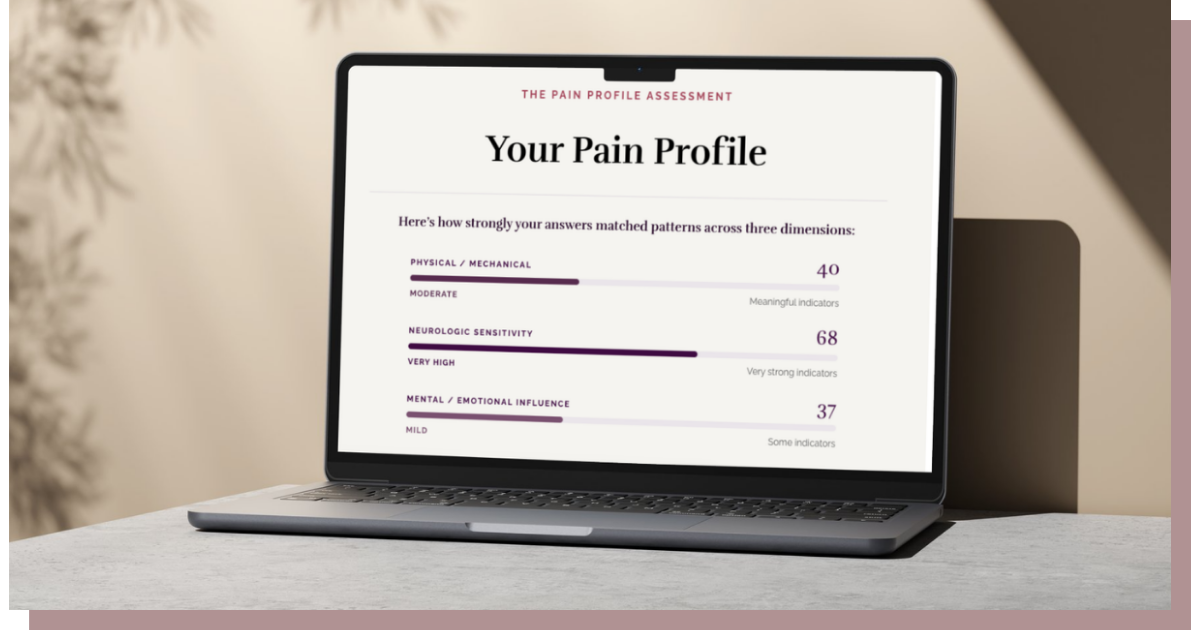
Not sure which dimension is driving your pain? Take the free Pain Profile quiz and get three separate scores: physical, neurologic sensitivity, and mental/emotional.
If neurologic sensitivity turns out to be the driver, that's exactly what The Uprising: Complex Pain Academy is built to address. A diagnosis is where the conversation starts. A plan is where it should have gone next.