Fibromyalgia and CRPS: Different Diagnoses, One Shared Layer Underneath
If you have been diagnosed with fibromyalgia, CRPS, or another chronic pain syndrome, or you are still waiting for a diagnosis that fits, you already know how much weight a label carries. It decides which specialist you see, what sits at the top of your chart, and how the next provider hears your symptoms. I work exclusively with complex and persistent pain, and I want to offer a different way to look at diagnostic labels like these. The label describes a pattern of symptoms. The mechanism underneath is what responds to treatment.
What a Chronic Pain Diagnosis Actually Does
The world is becoming more and more focused on labels. Personality types. Love languages. Dietary identities. And I understand why. Labels help us make sense of things. They can make us feel seen and validated, like we finally belong to a group that gets it.
In medicine, that matters. A diagnosis can put a name to something that has been dismissed for years. It can open doors to care and connect you with people who understand. I am not here to talk anyone out of their diagnosis.
But a diagnosis is a description. Present with one set of symptoms, and you get the CRPS label. Present with a different set, and you get the fibromyalgia label. Neither label, on its own, tells you what is driving the pain or what to do next.
And just as much as labels can feel inclusive, they can be exclusive. They can box us in. They can box others out. People with complex pain rarely fit neatly into cookie-cutter boxes.
For complex and persistent pain
Something is being missed.
The Uprising: Complex Pain Academy is a structured, 5-phase program that targets the neurologic sensitivity behind persistent pain, in the right order and at the right dose, with a specialist guiding every step.
When the Label Becomes a Closed File
Picture a familiar scene. You sit on the crunchy white paper in a chilly exam room, working up the courage to mention a new sensation running down your leg. You rehearsed it the night before. The doctor has already glanced at your chart, and there it is, front and center: fibromyalgia.
Before you finish your sentence, you hear it: "Oh, that's your fibromyalgia."
Once a catch-all label is in the chart, everything tends to get attributed to it. The same thing happens with perimenopause and menopause. These diagnoses have become a way to close the file rather than open a real treatment plan. Labels with no instructions.
That kind of dismissal reveals a real gap in modern medicine: the inability to address complex problems with practical strategies. When a provider shrugs off a new symptom, what they are really saying is, "I don't have the tools to help you." That gap belongs to the system. You don't have to carry it.
Your curiosity and your concern do not make you a difficult patient. You deserve to know what you can do about your condition. And if something truly is "normal," you deserve, at the very least, to understand why it is happening.
The Question Mark Problem
Labels create a second problem for the people who don't quite match the criteria. If your symptoms land between categories, you are left holding a question mark instead of a diagnosis. Many people living with unexplained pain symptoms feel like they have to prove their pain is real before they are allowed to get help.
There is a flip side, too. For some people, getting the diagnosis is the hard part. It can bring up resistance: "I don't want to be part of that group." "I don't identify as someone with chronic pain." That reaction is human. It also deserves a better answer than another label.
Different Diagnoses, One Shared Layer Underneath
First, to be clear: fibromyalgia and CRPS are different conditions, with different diagnostic criteria and different patterns. Having one does not mean you have, or will develop, the other.
Here is what I want every person caught in the diagnostic labeling mess to hear: neurologic adaptations can happen to anyone.
When pain persists, the signaling system adapts. Pain pathways that fire often become overactive. The protective response stays switched on long after the original reason for it has passed. The brain's map of the painful area can become smudged, so it struggles to read what is happening there and errs on the side of protection. I call the combined result neurologic sensitivity.
Those adaptations look different from person to person. In one person, they concentrate in a single limb. In another, they spread across the body. One person's symptom pattern earns a CRPS diagnosis, another's earns fibromyalgia, and a third person's earns a question mark.
Each condition deserves to be assessed on its own terms. But the neurologic sensitivity layer underneath responds to the same principles, regardless of which diagnostic label matches your particular set of symptoms.
Why the Mechanism Matters More Than the Label
I am a big believer in understanding why something is happening, for two reasons. First, understanding reduces fear and uncertainty, and in many cases that reduces symptoms too. Second, it informs more appropriate, effective action.
When you treat the label, you get a list of symptoms to manage one at a time. When you address the mechanism, you work on the sensitivity that is producing those symptoms in the first place. That is a very different plan.
Addressing neurologic sensitivity draws on evidence-based methods: pain neuroscience education, the Graded Motor Imagery sequence, sensory discrimination, neurodynamic techniques, pacing adapted for a sensitive system, and progressive strengthening once sensitivity settles. What decides whether those methods help or flare you is the dose, the order, and how they are adjusted to the person in front of me. That part does not change with the diagnosis code.
Your Diagnosis Is Not Your Destination
A label can be a useful starting point. It does not determine what is possible for you.
Your pain system is able to adapt. With the right guidance, it can become less protective, less reactive, and less sensitive. Whether your chart says fibromyalgia, CRPS, or nothing at all, the question worth asking is the same: what is actually driving this pain, and what does it respond to?
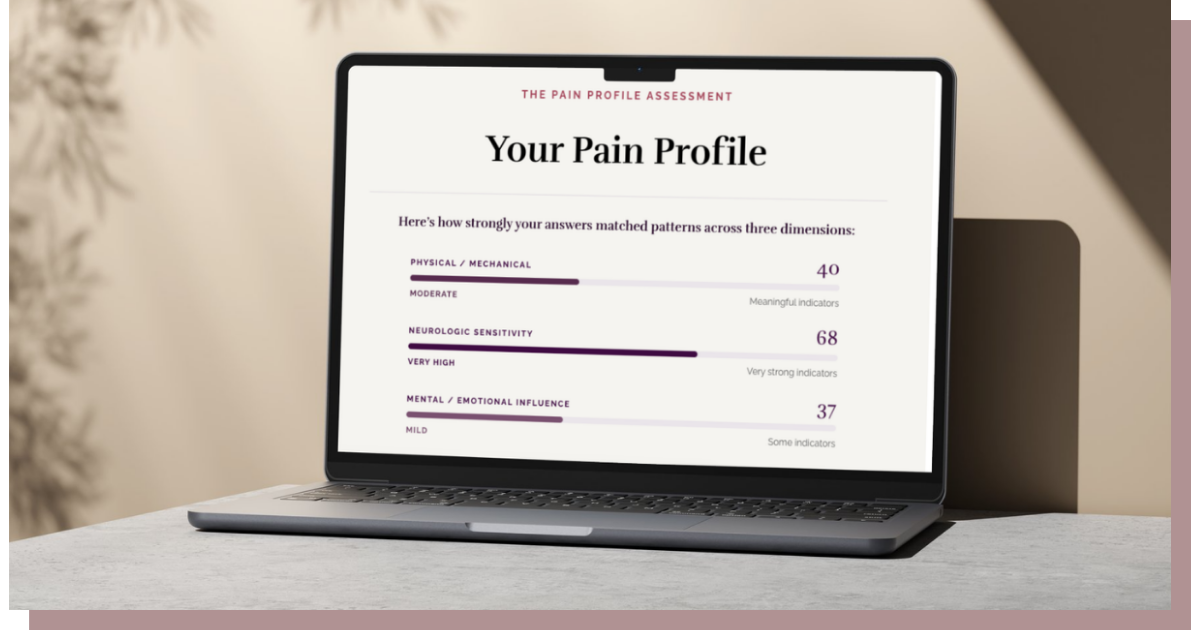
Not sure which dimension is driving your pain? Take the free Pain Profile quiz and get three separate scores: physical, neurologic sensitivity, and mental/emotional.
If neurologic sensitivity turns out to be the driver, that's exactly what The Uprising: Complex Pain Academy is built to address.