How to Treat Neurologic Sensitivity: Skills vs. Drills in Chronic Pain and CRPS Recovery
When someone asks what treating neurologic sensitivity actually involves, they usually expect one of two answers: a list of techniques to try, or a suggestion to relax and think differently. Neither one is a treatment plan. A real neurologic approach to persistent pain is built from two different kinds of work, skills and drills, and you need both. Here is what each one is, why one without the other fails, and what we can learn from how stroke rehab is done.
Nobody Calls Stroke Rehab "Mindset Work"
Over a decade in, and I still don't get it.
When someone has a stroke and goes to neuro rehab, nobody calls it mindset work. Nobody thinks they're working on their neurologic system because their symptoms are "all in their head." We understand that the neurologic system can change, and that it can be trained.
Nobody asks that patient about her childhood first. Nobody suggests she work on her outlook. She gets a structured neurologic program because her neurologic system is what changed.
And nobody blinks when the same patient also needs orthopedic rehab to rebuild strength, mobility, and balance. We understand that a stroke patient benefits from both neuro and ortho approaches, running side by side.
So why is it, when I suggest a neurologic approach for someone with persistent pain, people suddenly hear: "It's all in your head. Just relax. Think positive. Calm down"?
Why a Neurologic Approach to Pain Is Not Far-Fetched
Actual nerves and signaling pathways are involved in detecting, transmitting, mapping, and responding to information in every body. That system adapts, the same way muscle adapts to load.
When pain becomes unusually reactive, disproportionate, persistent, "nervy," widespread, easily provoked, slow to settle, or sensitive to things that shouldn't normally hurt, those are clues that the neurologic system may be part of what has changed. In CRPS, those changes are the condition itself. I lay out the full set of clues in Is Your Nervous System Hypersensitive?
At that point, addressing the neurologic signaling is the obvious move. I'm not talking about lying on the floor breathing, journaling about your childhood, or repeating "I'm safe" to yourself. I'm talking about training. I think of it as a combination of two things: skills and drills.
Drills: Training the Neurologic System Directly
Drills are the techniques we use to directly train different aspects of neurologic function, including how your system detects and distinguishes sensory information like touch, temperature, pressure, movement, and body position.
Depending on the person, that may include:
- Left/right discrimination (laterality training)
- Motor imagery
- Sensory discrimination
- Nerve drills based on neurodynamics, modified for a sensitive system
- Mirror-based techniques
Each drill does a different job. Some train the neurologic system to get better at distinguishing and mapping information. Others disrupt automatic responses to certain inputs that have become predictive and habitual. And some gradually normalize the reactivity of the nerves themselves.
In other words, neurologic pathways adapt to training just like muscles do. It's just a different kind of training.
You Wouldn't Max Out Five Lifts on Day One
Just like you wouldn't walk into a gym and max out five different lifts on your first day, we don't throw every neurologic drill at a sensitive system all at once.
We introduce them one at a time. We watch the response. We adjust before moving ahead. Someone handed a mirror, a scrub brush, and an exercise sheet with a "good luck" has been handed a pile of techniques, not a plan. The sequence and the dose are the plan.
Skills: The Part Almost Nobody Is Handed
Drills are only half of it. You could do the world's greatest sensory discrimination drill for five minutes, then bulldoze through your weekend and spend the next week in a full-blown flare. The drill didn't fail. The week around it did.
That's where the skills come in. They are the part almost nobody is taught, and they are what make the drills stick:
- Learning to push to it, not through it, so you can challenge things just enough to create adaptation without repeatedly overwhelming the system.
- Preventing unnecessary pain spikes, and knowing exactly what to do when one starts.
- Recognizing the cumulative factors that change how much your system can handle from one day to the next.
- Gradually rebuilding activity tolerance, strength, mobility, balance, and endurance without treating every symptom increase as failure or as something to bulldoze through.
Skills are what let you live inside a plan instead of just owning a list of exercises. When a flare does happen, the skill is knowing how to handle it. I walk through that in How to Handle a Flare-Up.
Why You Need Both Skills and Drills
The drills train the neurologic system directly. The skills help you navigate symptoms, adjust the challenge, and progressively rebuild what your body can do without paying for it all week.
Drills without skills produce flare-ups. Skills without drills produce management without adaptation. Together, they create the conditions for neurologic adaptation, and that is the goal.
What Stroke Rehab Gets Right That Pain Care Gets Wrong
Go back to the stroke patient. Nobody hands her a few techniques and says "good luck." She gets a sequence. A starting point matched to what she can currently do. Someone helping her adjust week by week. And when something provokes a bad response, nobody concludes that rehab doesn't work for her. The plan gets tweaked.
Nobody promises her the arm will be exactly what it was, either. What she gets promised is that what can be trained will be trained.
That is the standard I hold for complex pain. A stroke patient would never be handed the drills and left to sort out the dose herself. Being handed techniques isn't a plan. And "there's nothing more we can do" is not an evidence-based statement.
The Physical and the Neurologic Are Not a Choice
I started as an orthopedic PT before specializing in complex pain and neurologic sensitivity. So when I tell you that you shouldn't have to choose between the physical and the neurologic pieces, I mean it. The stroke patient gets both. So should you.
The Uprising: Complex Pain Academy is the framework I've built, tested, tweaked, and improved over more than a decade of this work. It gives you a strategic plan so you know what to do, how to do it, when to introduce each step, and how to adapt the plan to fit your needs, with the skills and the drills in the right order.
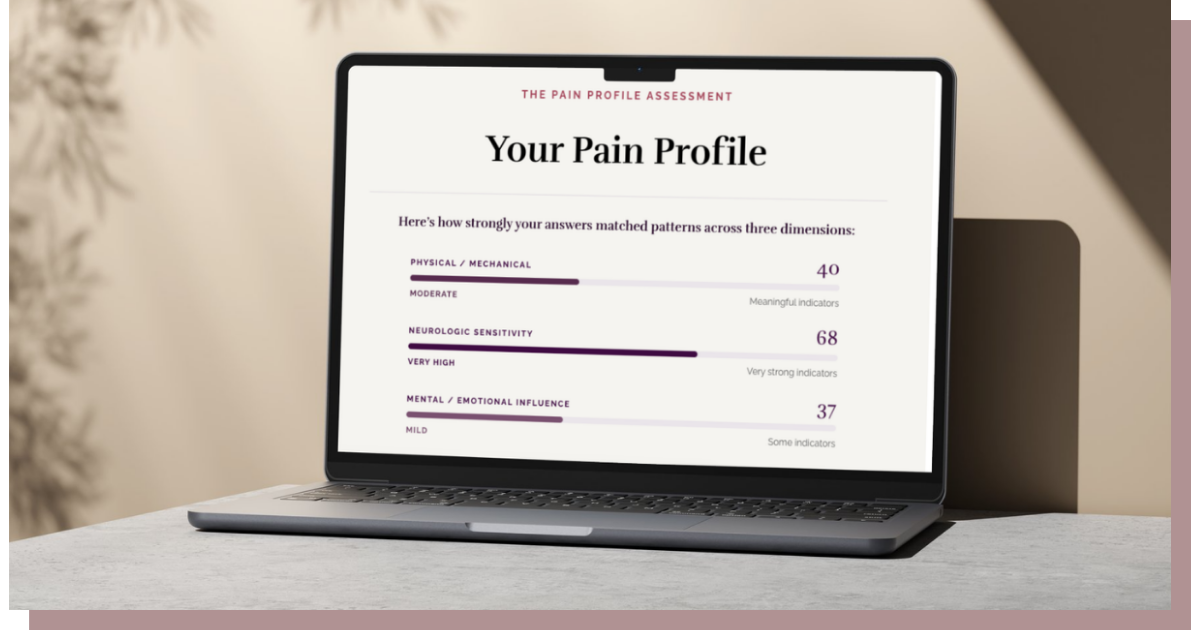
Not sure which dimension is driving your pain? Take the free Pain Profile quiz and get three separate scores: physical, neurologic sensitivity, and mental/emotional.
If neurologic sensitivity turns out to be the driver, that's exactly what The Uprising: Complex Pain Academy is built to address.