Pacing Chronic Pain: Why You Push to It, Not Through It
Most people with chronic pain end up in one of two patterns. Either they avoid whatever hurts until their world shrinks, or they push through the pain and pay for it later in a flare. Pacing is the alternative to both, and it is one of the most misunderstood tools in chronic pain care. In this article I explain why avoidance and the push-and-crash cycle both strengthen pain, what pacing actually is, and why I describe it with one phrase: push to it, not through it.
How Avoidance Shrinks Your World
As humans, we tend to avoid the things that cause us pain. That instinct makes sense in the short term. Over months and years, it quietly takes over.
It usually starts with one movement. Bending hurts, so you stop bending. Then it bleeds into everything similar: squatting, picking things up off the floor, putting on shoes, tidying up, cooking, sitting for long stretches, playing with your kids, riding a bike. As the list of things you can't do gets longer, your world gets smaller.
I once spoke with a mother who told me she could no longer bend down, put on her own shoes, or lift anything around the house. Her husband had taken over most of the chores, and she was afraid to play with her children. "This isn't the kind of mother I want to be," she said. As a mother myself, that conversation stayed with me. I hear some version of it every week.
Why Avoidance Makes Pain Worse
Nobody teaches you that the protective habits you develop around pain can make the pain problem worse. Ignoring the painful area, bracing it, compensating around it, immobilizing it, mentally checking out from it. Each one feels like protection.
The more we immobilize, avoid, and neglect a painful region, the less clear the brain's picture of that region becomes. I call this smudging. Think of a security guard watching a wall of surveillance monitors. When one of the screens goes fuzzy and the guard can't make out what is happening in that part of the building, the safest move is to sound the alarm and call for backup, just in case. A smudged map works the same way. When the brain can't read an area clearly, it errs on the side of protection, and protection shows up as pain.
That is why avoidance shrinks tolerance. Less use leads to a fuzzier map, a fuzzier map leads to more protection, and more protection feeds fear of movement, which makes the next movement feel even riskier.
For complex and persistent pain
Something is being missed.
The Uprising: Complex Pain Academy is a structured, 5-phase program that targets the neurologic sensitivity behind persistent pain, in the right order and at the right dose, with a specialist guiding every step.
Why Pushing Through Pain Strengthens Pain Pathways
The opposite pattern is just as common, especially among people with full lives. One client of mine had young kids, a partner who traveled for work, and a demanding job. She had lived with stubborn pain for well over a decade, and she pushed through it because she felt she had no other choice. Then she would spend time in bed recovering, worrying about the next flare, and rationing her energy.
This push-and-crash cycle often gets reinforced by the people who are supposed to help. Have you ever been told to work harder on your exercises, or that "if it hurts more, it means it's working"?
Here is the problem. The nervous system is constantly changing and adapting, and pathways that get used often get stronger. That is how you learned to tie your shoes. After enough repetition, it became automatic. The same process can build an automatic pathway for pain. Every time you push into pain or through pain, you practice that pathway. Over time it becomes easier for the system to activate pain and harder to switch it off. You develop something like muscle memory for pain.
I don't share this so anyone will feel guilty. If pushing through has been your coping strategy, it is because nobody showed you a better one. Until now, pushing through and paying for it later probably looked like the only way to get anything done.
What Pacing Is: Push to It, Not Through It
Pacing sits between those two patterns. It lets you do activities that could provoke pain without actually provoking it. You approach the edge of your symptoms, and you stop at the edge instead of crossing it.
That is what I mean by push to it, not through it. You keep engaging with the movements and activities that matter to you, so the brain keeps receiving clear information from those areas. And you stay under the threshold that would reinforce the pain pathway. Done consistently, pacing works on both problems at once. The map gets clearer, and the pain pathway gets less practice.
The benefits are physical and neurologic. That client who pushed through for over a decade eventually learned to pace her activities, movements, and exercises inside a structured plan. Her pain on its worst days came down dramatically, and she got most of her daily function back.
Pacing Is a Skill You Build Over Time
I won't sugarcoat it. Pacing is hard, and it is never perfect. That is especially frustrating for perfectionists, and many of my clients are perfectionists.
Most people try pacing on their own, struggle with it for a week or so, decide they failed, and give up. That reaction treats pacing like a test you either pass or fail. Pacing is a skill. You learn it, you practice it, and you get better at it over time. A day where you overshoot the edge does not erase your progress. It gives you information.
In my framework, pacing belongs with the skills. Drills train the signaling system directly. Skills like pacing carry that work into the dishes, the school run, and the walk with a friend. Both matter.
Why Pacing Works Better With Structure
Where you start, how you build, and what to do when symptoms rise are individual decisions. They depend on your current tolerance, your sensitivity, your fears, and the activities that matter most to you. Get those decisions right, and pacing builds tolerance. Get them wrong, and it turns into another thing that "didn't work." That is why I teach pacing as part of a structured plan with support built around it, so people stick with it long enough to see what it can do.
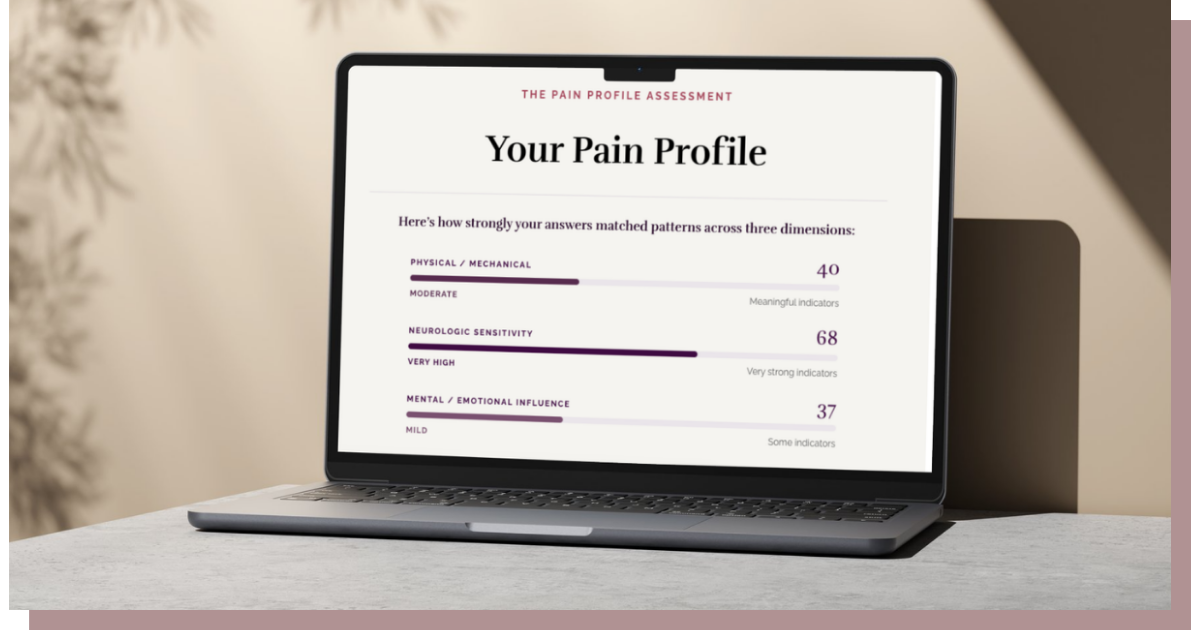
Not sure which dimension is driving your pain? Take the free Pain Profile quiz and get three separate scores: physical, neurologic sensitivity, and mental/emotional.
If neurologic sensitivity turns out to be the driver, that's exactly what The Uprising: Complex Pain Academy is built to address.