What to Expect From a Complex Pain Program: Inside a 5-Phase Neurologic Approach to Chronic Pain and CRPS
If you've spent any time looking for help with complex or persistent pain, you already know how much of the pain relief industry runs on big promises. Magic fixes. Miracle stories. A new method every month that claims to be the thing everyone else missed. So before you decide whether a structured pain program is worth your time, you deserve to know what actually happens inside one. Here is what working with me looks like, and why I've built it to be the opposite of a magic show.
What Dorothy Figured Out About Pain Recovery
My son watched The Wizard of Oz for the first time recently, and the ending landed differently for me as a pain specialist than it did when I was a kid.
Dorothy spends the whole movie following the yellow brick road toward the Great and Powerful Oz, convinced he holds the solution. Then the curtain gets pulled back. The Wizard is a man frantically working levers. And it turns out Dorothy never needed him. She needed someone to help her recognize and use what she already had to get home.
That is a lot like how I think about recovery from complex pain.
Most people don't need to keep walking the yellow brick road looking for a magical solution. They need better insight into the neurologic factors driving their pain, and enough structure and guidance to know what to focus on, what to do next, and how to adjust every step of the way.
I Am Not the Expert in Your Body. You Are.
When I work with clients, my goal is not for you to become permanently dependent on me.
I am not the expert in your body. You are. You know your body and your experience better than anyone else, including me, including every specialist you've seen.
My job is different. My job is to help you understand what's happening in your signaling system, develop the skills to normalize neurologic signaling, and become increasingly confident navigating symptoms and recovery on your own. In Oz terms, I'm aiming to be more like Glinda and less like the Wizard. Glinda didn't do the work for Dorothy. She pointed her toward what she already had and showed her how to use it.
That matters for complex pain specifically, because complex pain doesn't resolve on a fixed timeline that ends the day a program ends. You will have symptoms to interpret, decisions to make, and flare-ups to manage long after our time together. If you walk away knowing how to do that, the work holds. If you walk away needing me for every decision, I didn't do my job.
The Wizard of Oz Energy in the Pain Relief Industry
Here is the part I can't stay quiet about. The amount of Wizard of Oz energy in the pain relief space is next level.
Big promises. Magic fixes. Miracle stories. Confident claims that this one thing is the answer you've been missing.
Pull back the curtain, and what's actually behind it is usually one of the following:
- A generic set of exercises that has nothing to do with the neurologic signaling system
- A repackaged breathing app
- A "think positive and tell yourself you're safe" pep talk
- Someone reteaching a method they picked up in a weekend certification or a book
None of those things are evil. Some of them have a place. But none of them are what they're being sold as, and after a while, everyone and everything starts to look like a Wizard. Someone frantically pulling levers, hoping nobody looks too closely.
The Hope, Cost, Letdown Cycle Does Its Own Damage
If you've been through that cycle more than once, you know something that people newer to this don't: the cycle itself does damage.
The hope. The cost. The letdown. Then starting over.
It isn't only your bank account that takes the hit. Going all in on something and watching it not work takes something out of you. It makes the next thing harder to try, even when the next thing is the right thing. I see this constantly with people who've had CRPS or persistent pain for years. They aren't lazy or unmotivated. They are tired of being disappointed, and that is a completely rational response to being sold a series of Wizards.
So if you're reading this with your guard up, good. Keep it up. I'd rather you ask hard questions about my program than take anyone's word for it, including mine.
Pulling Back My Own Curtain
In an industry full of Wizards, I decided the fairest thing I could do was show you exactly what's behind mine.
Here is what working with me inside The Uprising: Complex Pain Academy actually consists of.
A Five-Phase Protocol, Not a Pile of Techniques
The program is built on five phases: Decode, Stabilize, Expand, Normalize, Rebuild. Fourteen modules walk you through those phases in order, because order matters when the signaling system is sensitized. Most programs start with strengthening. That is exactly why they stall.
Each phase has a job:
- Decode teaches you what's actually driving your pain, so you stop making decisions based on bad information.
- Stabilize reduces the amplifiers pushing your sensitivity up and gets flare-ups under some control.
- Expand introduces the skills that change how your system responds to sensory and movement input, including graded motor imagery and sensory discrimination.
- Normalize progresses those skills and begins reintroducing movement and load without the push-and-crash cycle.
- Rebuild returns you to strengthening, activity, and the things you actually want to do, on a system that can now tolerate it.
Skills You Practice, Not Content You Consume
At every step, you are learning and practicing something specific. Pain neuroscience education that goes well beyond "your brain creates pain." The graded motor imagery sequence. Modified neurodynamic techniques. Sensory discrimination. Pacing strategies adapted for neurologic sensitivity. Progressive strengthening done in a way that pushes to the edge of your system's tolerance rather than through it.
These are skills, not drills. The difference is that a drill is something you do. A skill is something you can carry into any situation your body throws at you later. And none of it relies on calming practices as the main solution. Those reduce amplifiers, which is useful, but they don't train the signaling system itself. I explain the difference in Why Calming Your Nervous System Isn't Enough for Chronic Pain.
Structure With Flexibility Built In
Persistent pain is a complex problem, and complex problems don't respond to rigid scripts. The whole process is designed to give you structure, so you always know what to focus on and what comes next, and flexibility, so you can adjust the dose, the pace, and the specifics to what your body is actually doing this week.
That is especially essential with CRPS, where the same input produces wildly different responses on different days. A plan that can't flex is a plan that will eventually ask you to push through, and pushing through is how CRPS gets worse.
Two Ways to Go Through It
The Inner Circle is a sixteen-week, women-only cohort with weekly live coaching and direct messaging access to me Monday through Friday, so decisions get made with a specialist instead of alone at 2 a.m. Independent Study is the self-paced path through the same protocol, with optional 1:1 coaching if you want it.
If you want to see the inside of the program module by module, I walk through it in Inside The Uprising: Complex Pain Academy.
What I Won't Promise You
A real curtain pull includes what's not behind it.
I won't promise you'll be pain-free. I won't promise a timeline. I won't tell you that CRPS or years of persistent pain disappear because you finally found the right program. Anyone who promises those things is working levers.
What I will tell you is this: a sensitized signaling system is a trainable one. The neurologic adaptations that pushed your sensitivity up can adapt in the other direction when they're trained in the right dose and the right order. That is a clinical process with a structure behind it, and it's one you can learn to run yourself.
No ruby slippers required.
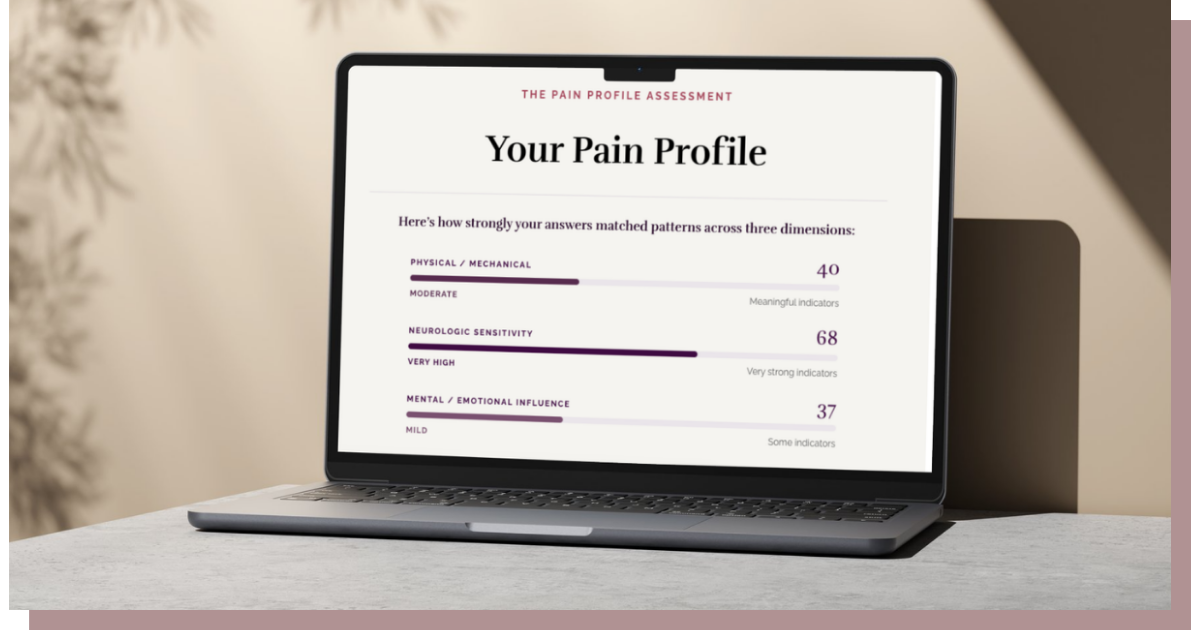
Not sure which dimension is driving your pain? Take the free Pain Profile quiz and get three separate scores: physical, neurologic sensitivity, and mental/emotional.
If neurologic sensitivity turns out to be the driver, that's exactly what The Uprising: Complex Pain Academy is built to address. When you're ready to find out whether it's a fit, you can submit an application here.