
How to Support Someone With Chronic Pain: What to Say and What to Avoid
Living with chronic pain is hard for obvious reasons, but what makes pain conditions worse is the isolation.
The loneliness that comes as a side effect of the condition can hurt more than the pain itself. Which is why it’s so extremely important to have a supportive circle.
In fact, that support is so important that it can even impact the person’s likelihood of recovery. Individuals with more support tend to have a better prognosis and tend to rely less on medications, have higher tolerance for activity, and lower pain levels.
It takes a special kind of person to want to learn to care for and support someone with chronic pain. But even those with the best intentions can say things that are hurtful and aren’t so supportive. It happens to all of us.
It’s human nature to want to fix things. When someone tells us about a problem they’re having, we automatically start thinking of solutions.
But unless you’re a medical professional, that person with chronic pain isn’t looking to you for solutions.
Support ≠ Solutions
Watching a loved one struggle with pain can make you feel helpless. But there are many ways you can offer support without attempting to “fix” them.
Sometimes a little extra guidance is required to know the right things to say and how to best support someone with chronic pain.
For complex and persistent pain
Something is being missed.
The Uprising: Complex Pain Academy is a structured, 5-phase program that targets the neurologic sensitivity behind persistent pain, in the right order and at the right dose, with a specialist guiding every step.
Say This, Not That
A few of the most common well-meaning misses, and what to say instead:
- Not that: “Have you tried yoga / turmeric / that new doctor?” Say this: “You know your body and your options better than I do. I’m here if you want to think anything through.”
- Not that: “But you look fine.” Say this: “I can’t see what you’re feeling, so tell me what today is actually like.”
- Not that: “At least it’s not something worse.” Say this: “This is hard, and it’s okay that it’s hard. I’m not going anywhere.”
Notice the pattern. Each “say this” drops the solution and picks up the person.
There are two ways to really support someone with chronic pain: First, is with your words... and second is with your actions...
I created a guide that shows you exactly what to say (and what not to say) AND what things you can do.
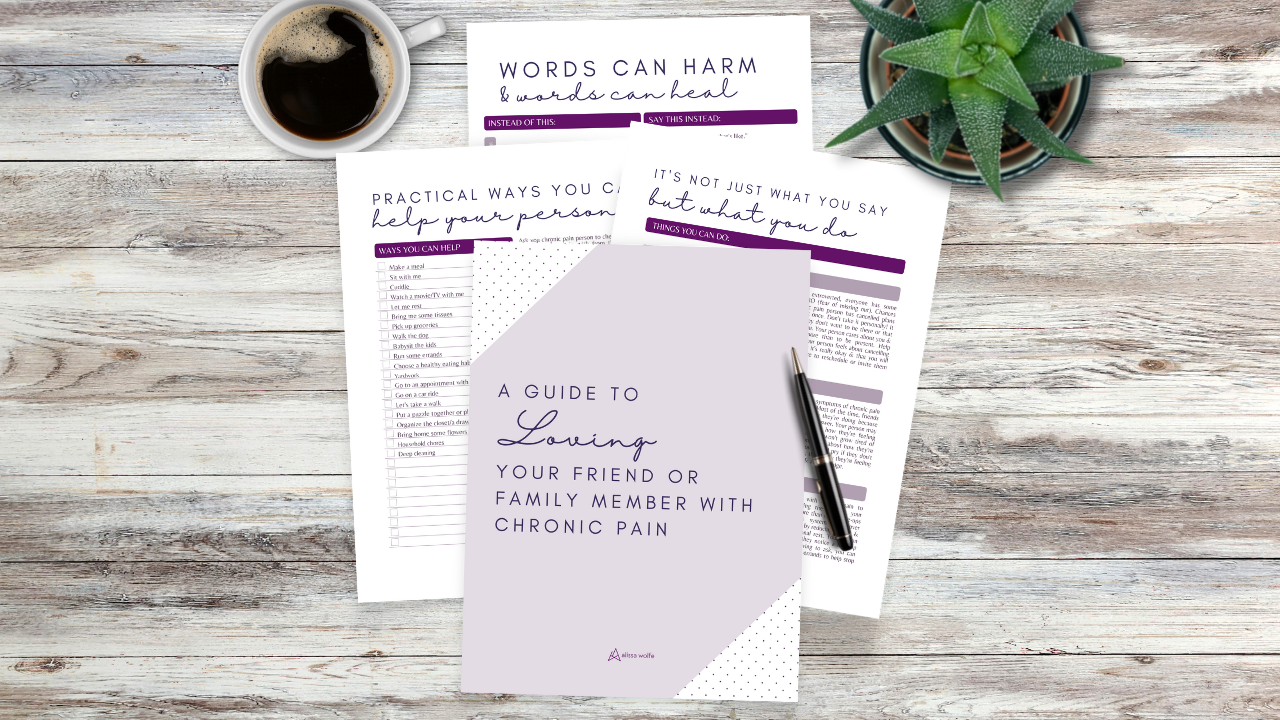
This guide has practical tools that will help anyone love and support their person with chronic pain better.
If you have a loved one with chronic pain, download this FREE guide and let them know what you learned!
Or, if you have chronic pain and you have someone who has showed they want to know how they can help you better, download this guide and send it their way.
Download the Guide to Loving Your Friend or Family Member With Chronic Pain here!
One more thing supporters can do: help your person understand what is actually driving their pain. The free Pain Profile quiz gives three separate scores — physical, neurologic sensitivity, and mental/emotional — and takes a few minutes. Send it to them, or sit down and go through it together. Knowing which dimension is driving the pain changes the conversation from “why aren’t you better yet?” to “what does this actually need?”
References:
Jamison RN, Virts KL. The influence of family support on chronic pain. Behaviour Research and Therapy. Volume 28, Issue 4, 1990. pg 283-287.




